A particle executes simple harmonic oscillation with an amplitude $a.$ The period of oscillation is $T.$ The minimum time taken by the particle to travel half of the amplitude from the equilibrium position is
AIPMT 2007, Medium


Download our appand get started for free
Experience the future of education. Simply download our apps or reach out to us for more information. Let's shape the future of learning together!No signup needed.*
Similar Questions
- 1The angular frequency of motion whose equation is $4\frac{{{d^2}y}}{{d{t^2}}} + 9y = 0$ is ($y =$ displacement and $t =$ time)View Solution
- 2The displacement of a particle executing simple harmonic motion is given byView Solution
$\mathrm{y}=\mathrm{A}_{0}+\mathrm{A} \sin \omega \mathrm{t}+\mathrm{B} \cos \omega \mathrm{t}$
Then the amplitude of its oscillation is given by
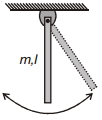
- 3A uniform rod of mass $m$ and length $I$ is suspended about its end, Time period of small angular oscillations is ..........View Solution
- 4A vertical mass spring system executes simple harmonic oscillations with a period of $2\,s$. A quantity of this system which exhibits simple harmonic variation with a period of $1\, sec$ isView Solution
- 5Infinite springs with force constant $k$, $2k$, $4k$ and $8k$.... respectively are connected in series. The effective force constant of the spring will beView Solution
- 6View SolutionThe phase difference between the instantaneous velocity and acceleration of a particle executing simple harmonic motion is
- 7A solid cylinder of density $\rho_0$, cross-section area $A$ and length $l$ floats in a liquid of density $\rho\left( >\rho_0\right)$ with its axis vertical, as shown. If it is slightly displaced downward and released, the time period will be .......View Solution
- 8A clock $S$ is based on oscillations of a spring and a clock $P$ is based on pendulum motion. Both clocks run at the same rate on earth. On a planet having same density as earth but twice the radius thenView Solution
- 9The displacement of a particle moving in $S.H.M.$ at any instant is given by $y = a\sin \omega t$. The acceleration after time $t = \frac{T}{4}$ is (where $T$ is the time period)View Solution
- 10A pendulume clock loses $12\;s$ a day if the temperature is $40^oC$ and gains $4\;s$ a day if the temperature is $20^oC$. The temperature at which the clock will show correct time, and the coeffecient of linear expansion $(\alpha)$ of the metal of the pendulum shaft are respectivelyView Solution