The displacement of a particle executing simple harmonic motion is given by
$\mathrm{y}=\mathrm{A}_{0}+\mathrm{A} \sin \omega \mathrm{t}+\mathrm{B} \cos \omega \mathrm{t}$
Then the amplitude of its oscillation is given by
NEET 2019, Medium


Download our appand get started for free
Experience the future of education. Simply download our apps or reach out to us for more information. Let's shape the future of learning together!No signup needed.*
Similar Questions
- 1The bob of a simple pendulum of mass m and total energy $E$ will have maximum linear momentum equal toView Solution
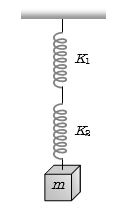
- 2A mass $M$ is suspended by two springs of force constants $K_1$ and $K_2$ respectively as shown in the diagram. The total elongation (stretch) of the two springs isView Solution
- 3A particle performs $S.H.M.$ of amplitude $A$ with angular frequency $\omega$ along a straight line. Whenit is at a distance $\frac{{\sqrt 3 }}{2}$ $A$ from mean position, its kinetic energy gets increased by an amount $\frac{1}{2}m{\omega ^2}{A^2}$ due to an impulsive force. Then its new amplitude becomesView Solution
- 4A simple pendulum has time period 't'. Its time period in a lift which is moving upwards with acceleration $3 ms ^{-2}$ isView Solution
- 5The amplitude of a particle executing $S.H.M.$ with frequency of $60 \,Hz$ is $0.01 \,m$. The maximum value of the acceleration of the particle isView Solution
- 6A pendulum is formed by pivoting a disc. What distance from center of mass, it should be pivoted for minimum time period while performing $SHM$ ?View Solution
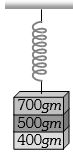
- 7Three masses $700g, 500g$, and $400g$ are suspended at the end of a spring a shown and are in equilibrium. When the $700g$ mass is removed, the system oscillates with a period of $3$ seconds, when the $500 \,gm$ mass is also removed, it will oscillate with a period of ...... $s$View Solution
- 8Two waves executing simple harmonic motion travelling in the same direction with same amplitude and frequency are superimposed. The resultant amplitude is equal to the $\sqrt{3}$ times of amplitude of individual motions. The phase difference between the two motions is $.....(degree)$View Solution
- 9A mass at the end of a spring executes harmonic motion about an equilibrium position with an amplitude $A.$ Its speed as it passes through the equilibrium position is $V.$ If extended $2A$ and released, the speed of the mass passing through the equilibrium position will beView Solution
- 10View SolutionIdentify correct statement among the following