MCQ
A particle executing simple harmonic motion along $Y- $axis has its motion described by the equation $y = A\sin (\omega \,t) + B$. The amplitude of the simple harmonic motion is
  • $A$
  • B
    $B$
  • C
    $A + B$
  • D
    $\sqrt {A + B} $

Answer

Correct option: A.
$A$
a
(a)The amplitude is a maximum displacement from the mean position.

Need a full question paper?

Generate a complete, print-ready paper with questions like this in minutes — across 16+ boards, with answer keys.
Start Generating Free

Similar questions

The power of a windmill having blade area equal to $A$ and wind velocity equal to $v$ is $(\rho$ is density of air$):$
A ball is thrown vertically up ward. It has a speed of $10\;m/sec$ when it has reached one half of its maximum height. How high ($m$ માં) does the ball rise? (Take $g = 10 \;m/s^2$)
A air bubble rises from bottom of a lake to surface. If its radius increases by $200 \%$ and atmospheric pressure is equal to water coloumn of height $H$. then depth of lake is ..... $H$
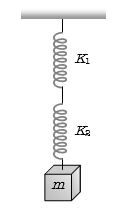
A mass $M$ is suspended by two springs of force constants $K_1$ and $K_2$ respectively as shown in the diagram. The total elongation (stretch) of the two springs is
Two cars ${X}$ and ${Y}$ are approaching each other with velocities $36\; {km} / {h}$ and $72\; {km} / {h}$ respectively. The frequency of a whistle sound as emitted by a passenger in car ${X}$, heard by the passenger in car ${Y}$ is $1320 \;{Hz}$. If the velocity of sound in air is $340\; {m} / {s}$, the actual frequency of the whistle sound produced is ........ $Hz.$
The dimensions of power are
A car of mass $500\, kg$ is driven with acceleration $1\, m/s^2$ along straight level road against constant external resistance of $1000\, N$. When the velocity is $5\, m/s$ the rate at which the engine is working is .............. $\mathrm{kW}$
Identify the correct definition
The displacement of a particle after time $t$ is given by $x = \left( {k/{b^2}} \right)\left( {1 - {e^{ - bt}}} \right)$ where $b$ is a constant. What is the acceleration of the particle? 
The radius of gyration of a disc of mass 100 g and radius 5 cm about an axis passing through its centre of gravity and perpendicular to the plane is