A particle in $SHM $ is described by the displacement equation $x(t) = A\cos (\omega t + \theta ).$ If the initial $(t = 0)$ position of the particle is $1 \,cm$ and its initial velocity is $\pi $cm/s, what is its amplitude? The angular frequency of the particle is $\pi {s^{ - 1}}$
Easy
Download our app for free and get started
(b) Given, $v = \pi \,cm/\sec ,$ $x = 1\,cm$ and $\omega = \pi {s^{ - 1}}$
using $v = \omega \sqrt {{a^2} - {x^2}} $
using $v = \omega \sqrt {{a^2} - {x^2}} $
==> $\pi = \pi \sqrt {{a^2} - 1} $
$ \Rightarrow 1 = {A^2} - 1$
$ \Rightarrow A = \sqrt 2 \,cm.$

Download our appand get started for free
Experience the future of education. Simply download our apps or reach out to us for more information. Let's shape the future of learning together!No signup needed.*
Similar Questions
- 1The amplitude of a particle executing $SHM$ about $O$ is $10\, cm.$ Then :View Solution
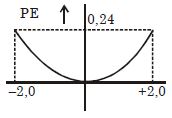
- 2A particle executing $S.H.M.$ its potential energy $V/S$ displacement graph is given by The value of restoring force constant is ..... $N/m$View Solution
- 3If $< E >$ and $< U >$ denote the average kinetic and the average potential energies respectively of mass describing a simple harmonic motion, over one period, then the correct relation isView Solution
- 4View SolutionIn simple harmonic motion, the ratio of acceleration of the particle to its displacement at any time is a measure of
- 5A body executing simple harmonic motion has a maximum acceleration equal to $ 24\,metres/se{c^2} $ and maximum velocity equal to $ 16\;metres/sec $. The amplitude of the simple harmonic motion isView Solution
- 6If a simple harmonic oscillator has got a displacement of $0.02\, m$ and acceleration equal to $2.0\,m{s^{ - 2}}$ at any time, the angular frequency of the oscillator is equal to .... $rad\,{s^{ - 1}}$View Solution
- 7A body is vibrating in simple harmonic motion with an amplitude of $0.06\, m$ and frequency of $15\, Hz$. The velocity and acceleration of body isView Solution
- 8A $15 \,g$ ball is shot from a spring gun whose spring has a force constant of $600 \,N/m$. The spring is compressed by $5 \,cm$. The greatest possible horizontal range of the ball for this compression is .... $m$ ($g = 10 \,m/s^2$)View Solution
- 9Two particle executing $S.H.M.$ of same amplitude of $20 \,cm$ with same period along the same line about same equilibrium position. The maximum distance between the two is $20 \,cm$. Their phase difference in radian is equal toView Solution
- 10The displacement of a particle varies according to the relation $x = 4(cos\pi t + sin\pi t).$ The amplitude of the particle isView Solution