MCQ
A particle is in linear simple harmonic motion between two points A and B, 10cm apart Take the direction from A to B as the + ve direction and choose the correct statements:

  • A
    The sign of velocity, acceleration and force on the particle when it is 3cm away from A going towards B are positive.
  • B
    The sign of velocity of the particle at C going towards O is negative.
  • C
    The sign of velocity, acceleration and force on the particle when it is 4cm away from B going towards A are negative.
  • D
    The sign of acceleration and force on the particle when it is at point B is negative.
Answer

  1. The sign of velocity, acceleration and force on the particle when it is 3cm away from A going towards B are positive.
  1. The sign of velocity, acceleration and force on the particle when it is 4cm away from B going towards A are negative.
  1. The sign of acceleration and force on the particle when it is at point B is negative.
Explanation:

  1. when the particle is going from A to B (+ve direction) and it is 3 cm from A velocity increases up to O so velocity is positive. Acceleration in SHM is towards +ve. So both v and a are +ve.
  2. As the particle is going towards B so velocity is Positive not negative.
  3. As the particle is at 4cm from B and B and going towards A i.e. (-)ve side, so velocity and acceleration towards mean position at O. So both are negative.
  4. When particle is at B force and acceleration both are towards ‘O’, so both are negative.

Need a full question paper?

Generate a complete, print-ready paper with questions like this in minutes — across 16+ boards, with answer keys.

Start Generating Free

Similar questions

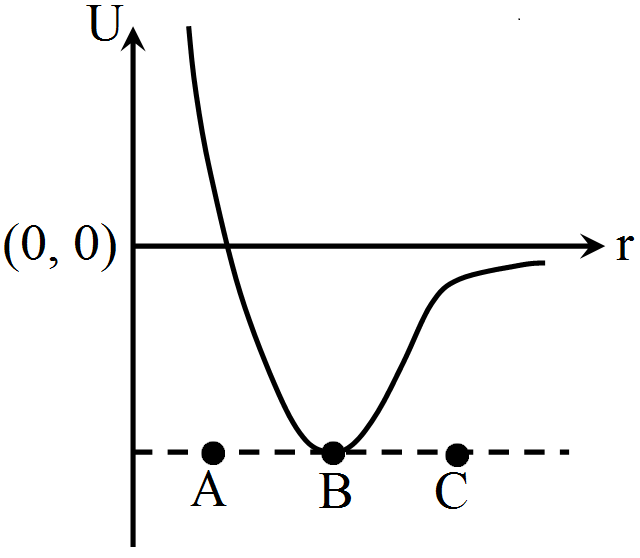
The potential energy U between two molecules as a function of the distance r between them has been shown in the adjoining figure. The two molecules are:

The satellite of mass $m$ revolving in a circular orbit of radius $r$ around the earth has kinetic energy $E$. Then its angular momentum will be
Four simple harmonic vibrations:

${y_1} = 8\,\cos\, \omega t;\,{y_2} = 4\,\cos \,\left( {\omega t + \frac{\pi }{2}} \right)$ ; 

${y_3} = 2\cos \,\left( {\omega t + \pi } \right);\,{y_4} = \,\cos \,\left( {\omega t + \frac{{3\pi }}{2}} \right)$ , 

are superposed on each other. The resulting amplitude and phase are respectively;

The path Difference between the two waves ${y_1} = {a_1}\,\sin \,\left( {\omega t - \frac{{2\pi x}}{\lambda }} \right)$ and ${y_2} = {a_2}\,\cos \,\left( {\omega t - \frac{{2\pi x}}{\lambda } + \phi } \right)$ is
The equation of a wave travelling on a string is $y=4 \sin \left[\frac{\pi}{2}\left(8 t-\frac{x}{8}\right)\right]$ where $x , y$ are in cm and t in second. The velocity of the wave is
A wooden object floats in water kept in a beaker. The object is near a side of the beaker. Let P1, P2, P3 be the pressures at the three points A, B and C of bottom as shown in the figure.
  1. P1 = P2 = P3
  2. P1 < P2 < P3
  3. P1 > P2 > P3
  4. P2 = P3 ≠ P1
A ball of mass $150\,g$ starts moving with an acceleration of $20m/{s^2}$. When hit by a force, which acts on it for $0.1\, sec$. The impulsive force is ........ $N-s$
A cuboidal piece of wood has dimensions $a, b$ and $c$. Its relative density is $d$. It is floating in a large body of water such that side a is vertical. It is pushed down a bit and released. The time period of $SHM$ executed by it is :
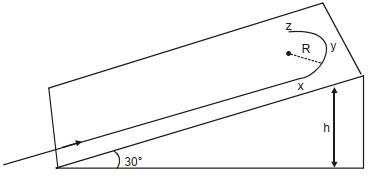
A student skates up a ramp that makes an angle $30^{\circ}$ with the horizontal. $He /$ she starts (as shown in the figure) at the bottom of the ramp with speed $v_0$ and wants to turn around over a semicircular path xyz of radius $R$ during which he/she reaches a maximum height $h$ (at point y) from the ground as shown in the figure. Assume that the energy loss is negligible and the force required for this turn at the highest point is provided by his/her weight only. Then ( $g$ is the acceleration due to gravity)

$(A)$ $v_0^2-2 g h=\frac{1}{2} g R$

$(B)$ $v_0^2-2 g h=\frac{\sqrt{3}}{2} g R$

$(C)$ the centripetal force required at points $x$ and $z$ is zero

$(D)$ the centripetal force required is maximum at points $x$ and $z$

Two waves of same frequency and intensity superimpose with each other in opposite phases, then after superposition the