Question
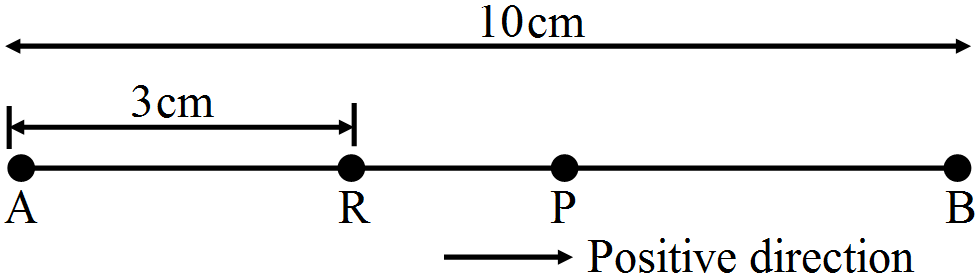
A particle is in linear simple harmonic motion between two points A and B, 10cm apart. Take the direction from A to B as positive direction and give the signs of velocity and acceleration on the particle when it is:
  1. At the end B.
  2. At 3cm away from A going towards B.

Answer


  1. At the end B velocity is zero. Here acceleration and force are negative as they are directed along BR i.e., along negative direction.
  2. At 3cm away from A going towards B, the particle is at R, with a tendency to move along RP which is positive direction, here velocity, acceleration are all positive.

Need a full question paper?

Generate a complete, print-ready paper with questions like this in minutes — across 16+ boards, with answer keys.

Start Generating Free

Similar questions

One end of a rod of length 20cm is inserted in a furnace at 800K The sides of the rod are covered with an insulating material and the other end emits radiation like a blackbody. The temperature of this end is 750K in the steady state. The temperature of the surrounding air is 300K. Assuming radiation to be the only important mode of energy transfer between the surrounding and the open end of the rod, find the thermal conductivity of the rod. Stefan constant $\sigma=6.0\times10^{-8}\text{Wm}^{-2}\text{K}^{-4}.$
On what factors does the magnitude of heat flow from hot surface to cold surface depends? How?
Consider Galileo's method of measuring the speed of light using two lanterns. To get an accuracy of about 10%, the time taken by the experimenter in closing or opening the shutter should be about one tenth of the time taken by the light in going from one experimenter to the other. Assume that it takes $\frac{1}{100}$ second for an experimenter to close or open the shutter. How far should the two experimenters be to get a 10% accuracy? What are the difficulties in having this separation?
The position of a particle is given by:
$\vec{\text{r}}=3.0\text{t}\hat{\text{i}}-2.0\text{t}^2\hat{\text{j}}+4\hat{\text{k}}\text{ m}$ 
where t is in seconds, r is in metres and the coefficients have the proper units.
  1. Find the velocity v and acceleration a.
  2. What is the magnitude of velocity of the particle at t = 2s?
A concave mirror has a focal length of 20cm. Find the position or positions of an object for which the imagesize is double of the object-size.
Find the ratio of the linear momenta of two particles of masses 1.0kg and 4.0kg if their kinetic energies are equal.
Explain that torque is only due to transverse component of force. Radial component has nothing to do with torque.
Four persons K, L, M and N start from the vertices of a square of side 'a', simultaneously and move towards the neighbour in order always with the same speed of v. When and where do they meet?
A proton describes a circle of radius 1cm in a magnetic field of strength 0.10T. What would be the radius of the circle described by an α-particle moving with the same speed in the same magnetic field?
Answer the following :
(a) You are given a thread and a metre scale. How will you estimate the diameter of the thread?
(b) A screw gauge has a pitch of 1.0 mm and 200 divisions on the circular scale. Do you think it is possible to increase the accuracy of the screw gauge arbitrarily by increasing the number of divisions on the circular scale?
(c) The mean diameter of a thin brass rod is to be measured by vernier callipers. Why is a set of 100 measurements of the diameter expected to yield a more reliable estimate than a set of 5 measurements only?