Question
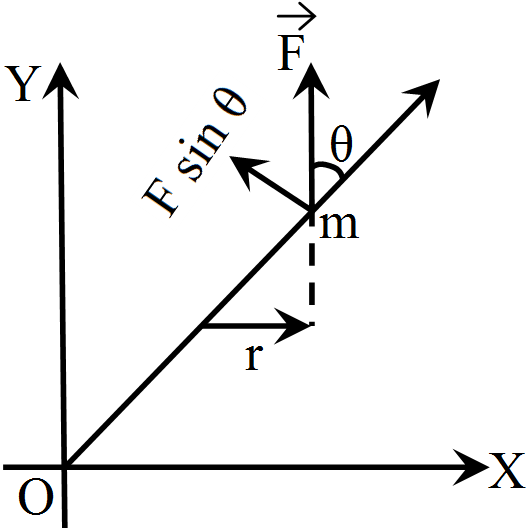
Explain that torque is only due to transverse component of force. Radial component has nothing to do with torque.
Answer

Torque is defined as the moment of force.

$\tau=\vec{\text{r}}\times\vec{\text{F}}=\text{r}\text{ F}\sin\theta\ \hat{\text{n}}.\hat{\text{n}}$  is along axis of rotation. If a force $\vec{\text{F}}$ acts at an angle $\theta$ to the position vector i then $\text{F}\sin\theta$ acts perpendicularly to the position- vector. Therefor $\tau=\text{r}_{\bot}\text{F}$ and so the radial component does not bring any influence on the torque.

Need a full question paper?

Generate a complete, print-ready paper with questions like this in minutes — across 16+ boards, with answer keys.

Start Generating Free

Similar questions

Estimate the number of electrons in 100g of water. How much is the total negative charge on these electrons?
A solid sphere of radius 10cm is subjected to a uniform pressure equal to 5 × 10⁸Nm-2. Calculate the change in volume. Bulk modulus of the material of the sphere is 3.14 × 10¹¹Nm-2.
Plot the corresponding reference circle for each of the following simple harmonic motions. Indicate the initial (t = 0) position of the particle, the radius of the circle, and the angular speed of the rotating particle. For simplicity, the sense of rotation may be fixed to be anticlockwise in every case: (x is in cm and t is in s).

$\text{x}=\cos\Big(\frac{\pi}{6}-\text{t}\Big)$
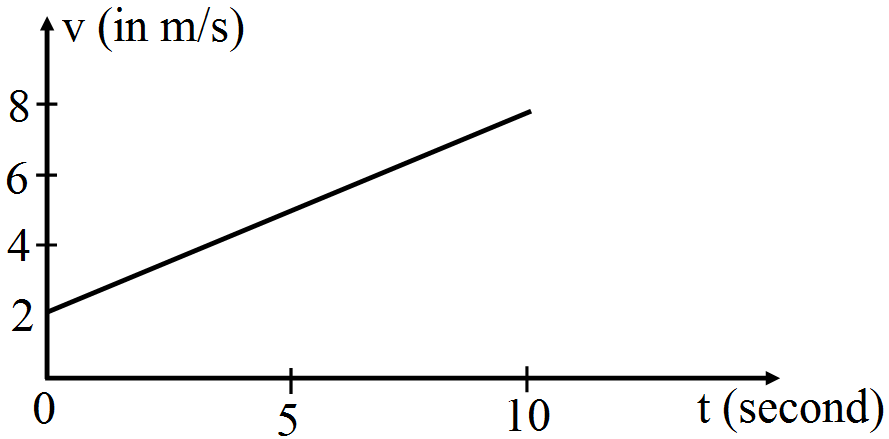
Figure shows the graph of velocity versus time for a particle going along the X-axis. Find:
  1. The acceleration.
  2. The distance travelled in 0 to 10s.
  3. The displacement in 0 to 10s.

A light wave is reflected from the mirror. The incident and the reflected waves superimpose to form stationary wave, but the nodes and anti-nodes are not seen. Why?
A body falls towards earth in air. Will its total mechanical energy be conserved during the fall? Justify
An electric bulb, when connected across a power supply of 220V, consumes a power of 60W. If the supply drops to 180V, what will be the power consumed? If the supply is suddenly increased to 240V, what will be the power consumed?
A man walking briskly in rain with speed v must slant his umbrella forward making an angle $\theta$ with the vertical. A student derives the following relation between $\theta$ and v: $\tan \theta = \text{v}$ and checks that the relation has a correct limit: as $\text{v}\rightarrow 0,\ \theta \rightarrow0,$ as expected. (We are assuming there is no strong wind and that the rain falls vertically for a stationary man). Do you think this relation can be correct? If not, guess the correct relation.
A body oscillates with SHM according to the equation (in SI units), $
x=5 \cos [2 \pi t+\pi / 4] \text {. }
$
At $t=1.5 s$, calculate the (a) displacement, (b) speed and (c) acceleration of the body.
A clever strategy in a snowball fight is to throw two snowballs at your opponent in quick succession. The first one with a high trajectory and the second one with a lower trajectory and shorter time of flight, so that they both reach the target at the same instant. Suppose your opponent is 20.0m away.
You throw both snowballs with the same initial speed vo but θ0 is 60.0° for the first snowball and 30.0° for the second. If they are both to reach their target at the same instant, how much time must elapse between the release of the two snowballs?