MCQ
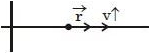
A particle is moving along a straight line with increasing speed. Its angular momentum about a fixed point on this line
  • A
    Goes on increasing
  • B
    Goes on decreasing
  • C
    May be increasing or decreasing depending on direction of motion
  • Remains zero

Answer

Correct option: D.
Remains zero
d
$\mathrm{L}=0$ because angle between $\overrightarrow{\mathrm{r}} \& \overrightarrow{\mathrm{v}}$ is always

zero (as point lies on the same line)

Need a full question paper?

Generate a complete, print-ready paper with questions like this in minutes — across 16+ boards, with answer keys.
Start Generating Free

Similar questions

Consider the situation of the previous problem. The directions of the magnetic field due to the dipole are opposite at:
Angle between the vectors $(\hat i + \hat j)$ and $(\hat j - \hat k)$ is ........ $^o$
The harmonics which are present in a pipe open at one end are
The volume of an ideal gas is $1$ litre and its pressure is equal to $72cm$ of mercury column. The volume of gas is made $900\, cm^3$ by compressing it isothermally. The stress of the gas will be ...... $cm$ (mercury)
As a wave propagates
A capillary tube is dipped in water and it is $20 \,cm$ outside water. The water rises upto $8 \,cm$. If the entire arrangement is put in freely falling elevator the length of water column in the capillary tube will be ........ $cm$
A particle starting from rest, moves in a circle of radius $r$. It attains a velocity of $\mathrm{V}_{0} \;\mathrm{m} / \mathrm{s}$ in the $\mathrm{n}^{\text {th }}$ round. Its angular acceleration will be
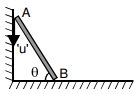
The velocity of end ' $A$ ' of rigid rod placed between two smooth vertical walls moves with velocity ' $u$ ' along vertical direction. Find out the velocity of end ' $B$ ' of that rod, rod always remains in constant with the vertical walls.
A ball thrown by a boy is caught by another after $2\ sec$. some distance away in the same level. If the angle of projection is $30^o $, the velocity of projection is  ......... $m/s$
$Assertion :$ Sound waves cannot travel in vacuum but light can travel in vacuum.
$Reason :$ Sound waves are longitudinal waves and they cannot be polarised but electromagentic waves are transverse and they can be polarised.