MCQ
As a wave propagates
  • A
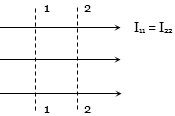
    The wave intensity remains constant for a plane wave
  • B
    Total intensity of the spherical wave over the spherical surface centered at the source remains constant at all times
  • C
    The wave intensity decreases as the inverse square of the distance from the source for a spherical wave
  • All of the above.

Answer

Correct option: D.
All of the above.
d
(d) For a travelling wave, the intensity of wave remainsconstant if it is a plane wave.
Intensity of wave is inversely proportional to the square of the distance from the source if the wave is spherical
$\left( {I = \frac{P}{{4\pi {r^2}}}} \right)$
Intensity of spherical wave on the spherical surface centred at source always remains same. Here total intensity means power $P$.

Need a full question paper?

Generate a complete, print-ready paper with questions like this in minutes — across 16+ boards, with answer keys.

Start Generating Free

Similar questions

An external pressure $P$ is applied on a cube at $0^o C$ so that it is equally compressed from all sides. $K$ is the bulk modulus of the material of the cube and a is its coefficient of linear expansion. Suppose we want to bring the cube to its original size by heating. The temperature should be raised by
Equal masses of three liquids $A, B$ and $C$ have temperatures $10\,^oC$, $25\,^oC$ and $40\,^oC$ respectively. If $A$ and $B$ are mixed, the mixture has a temperature of $15\,^oC$. If $B$ and $C$ are mixed then mixture has temperature of $30\,^oC$. If $A$ and $C$ are mixed, the mixture will have a temperature of ........ $^oC$
In simple harmonic motion, the ratio of maximum acceleration of the cup and maximum is :
Kepler discovered
Which of the following orbits is a possible orbit for a planet ?
If two liquids of same masses but densities $\rho_1$ and $\rho_2,$ respectively are mixed, then density of mixture is given by:
$Assertion :$ A brass tumbler feels much colder than a wooden tray on a chilly day.

$Reason :$ The thermal conductivity of brass is more than the thermal conductivity of wood.

A body starts from rest with uniform acceleration. If its velocity after $n$ second is $\upsilon ,$ then its displacement in the last two seconds is
A particle starting from the origin $(0, 0)$ moves in a straight line in the $(x, y)$ plane. Its coordinates at a later time are $(\sqrt 3 , 3) .$ The path of the particle makes with the $x-$axis an angle of ......... $^o$
Consider a magnetic dipole kept in the north to south direction. Let $P_1, P_2, Q_1, Q_2$ be four points at the same distance from the dipole towards north, south, east and west of the dipole respectively. The directions of the magnetic field due to the dipole are the same at: