MCQ
A particle is moving on a circular path with constant speed $v$. It moves between two points $A$ and $B$. which subtends an angle $60^{\circ}$ at the centre of circle. The magnitude of change in its velocity and change in magnitude of its velocity during motion from $A$ to $B$ are respectively ..........
  • A
    $0,0$
  • $v, 0$
  • C
    $0, v$
  • D
    $2 v, v$

Answer

Correct option: B.
$v, 0$
b
(b)

$\Delta v=2 v \sin \frac{\theta}{2}$

$=2 v \times \sin \left(\frac{60}{2}\right)$

$|\Delta v|=v$

Change in magnitude of velocity $=0$

Need a full question paper?

Generate a complete, print-ready paper with questions like this in minutes — across 16+ boards, with answer keys.

Start Generating Free

Similar questions

Consider the two statements related to circular motion in usual notations

$A$. In uniform circular motion $\vec{\omega}, \vec{v}$ and $\vec{a}$ are always mutually perpendicular

$B$. In non-uniform circular motion, $\vec{\omega}, \vec{v}$ and $\vec{a}$ are always mutually perpendicular

A diwali rocket of mass $100\,g$ lifts up with acceleration of $5\,m/s^2$. If gases eject out of rocket at a rate of $10\,g/s$, then find the velocity of ejection of gas w.r.t rocket. ............ $m/s$
A particle moves with constant angular velocity in circular path of certain radius and is acted upon by a certain centripetal force $F$. if the angular velocity is kept same but the radius of the path is halved, the new force will be
A vibrating string of certain length $l$ under a tension $T$ reasonates with a mode corresponding to the first overtone (third harmonic) of an air column of length $75$ $cm$ inside a tube closed at one end. The string also generates $4$ beats per second when excited along with a tuning fork of frequency $n$. Now when the tension of the string is slightly increased the number of beats reduces to $2$ per second. Assuming the velocity of sound in air to be $340$ $m/s$, the frequency $n$ of the tuning fork in $Hz $ is
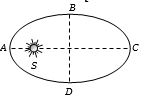
A planet is revolving around the sun as shown in elliptical path  the orbital velocity of the planet will be minimum at
A stick is thrown in the air and lands on the ground at some distance from the thrower. The centre of mass of the stick will move along a parabolic path:
A body of mass $1 kg$ begins to move under the action of a time dependent force $\vec{F}=\left(t \hat{i}+3 t^2 \hat{ j }\right) N$. where $\hat{i}$ and $\hat{j}$ are the unit vectors along $x$ and $y$ axis. The power developed by above force, at the time $t=2 s$. will be $..............W$.
A man is running at a speed of $5\, m/s$, the rain drops appear to be falling at an angle of $45^o$ from the vertical. If the rain drops are actually falling vertically downwards, then velocity of rain drops (in $m/s$) is
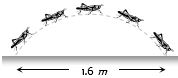
A grasshopper can jump maximum distance $1.6\; m$. It negligible time of the ground. How far can it go in $10 \;s$?
A man is at a distance of $6\,m$ from a bus. The bus begins to move with a constant acceleration of $3\,ms ^{-2}$. In order to catch the bus, the minimum speed with which the man should run towards the bus is $.........ms ^{-1}$