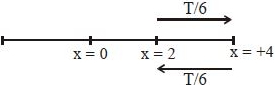
A particle is performing simple harmonic motion along $x$ -axis with amplitude $4\, cm$ and time period $1.2\, sec$. The minimum time taken by the particle to move from $x = 2\, cm$ to $x =+ 4 \,cm$ and back again is given by .... $s$
Medium


Download our appand get started for free
Experience the future of education. Simply download our apps or reach out to us for more information. Let's shape the future of learning together!No signup needed.*
Similar Questions
- 1The motion of a particle executing $S.H.M.$ is given by $x = 0.01\sin 100\pi (t + .05)$, where $x$ is in metres and time is in seconds. The time period is ..... $\sec$View Solution
- 2The periodic time of a body executing simple harmonic motion is $3\, sec$. After how much interval from time $t = 0$, its displacement will be half of its amplitude ..... $\sec$View Solution
- 3If $x=5 \sin \left(\pi t+\frac{\pi}{3}\right) \mathrm{m}$ represents the motion of a particle executing simple harmonic motion, the amplitude and time period of motion, respectively, areView Solution
- 4View SolutionThe velocity of a particle performing simple harmonic motion, when it passes through its mean position is
- 5Equations $y = 2A \cos ^2 \omega \,t$ and $y = A (\sin \omega t + \cos \omega t )$ represent the motion of two particles.View Solution
- 6The phase difference between two $SHM\,\,$ ${y_1}\, = \,10\,\sin \,\left( {10\pi t\, + \,\frac{\pi }{3}} \right)$ and ${y_2}\, = \,12\,\sin \,\left( {8\pi t\, + \,\frac{\pi }{4}} \right)$ at $t = 0.5\,s$ itView Solution
- 7View SolutionA hollow sphere is filled with water through a small hole in it. It is then hung by a long thread and made to oscillate. As the water slowly flows out of the hole at the bottom, the period of oscillation will
- 8When a mass $m$ is attached to a spring it oscillates with period $4 \,s$. When an additional mass of $2 \,kg$ is attached to a spring, time period increases by $1 \,s$. The value of $m$ is ........... $kg$View Solution
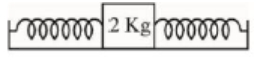
- 9A block of mass $2\,kg$ is attached with two identical springs of spring constant $20\,N / m$ each. The block is placed on a frictionless surface and the ends of the springs are attached to rigid supports (see figure). When the mass is displaced from its equilibrium position, it executes a simple harmonic motion. The time period of oscillation is $\frac{\pi}{\sqrt{x}}$ in SI unit. The value of $x$ is $..........$View Solution
- 10The motion of a particle as per $x=Asin \omega t + Bcos\omega t$ is :-View Solution