Equations $y = 2A \cos ^2 \omega \,t$ and $y = A (\sin \omega t + \cos \omega t )$ represent the motion of two particles.
Advanced


Download our appand get started for free
Experience the future of education. Simply download our apps or reach out to us for more information. Let's shape the future of learning together!No signup needed.*
Similar Questions
- 1A light balloon filled with helium of density $\rho_{ He }$ is tied to a long light string of length $l$ and the string is attached to the ground. If the balloon is displaced slightly in the horizontal direction from the equilibrium and released. Then,View Solution
- 2In damped oscillations, damping force is directly proportional to speed of oscillator. If amplitude becomes half of its maximum value in $1 \,s$, then after $2 \,s$ amplitude will be $\left(A_0-\right.$ initial amplitude)View Solution
- 3The acceleration of a particle performing S.H.M. is at a distance of $3\; cm$ from the mean position is $ 12\,cm/sec^2 $. Its time period is ..... $\sec$View Solution
- 4A block of mass $200\, g$ executing $SHM$ under the influence of a spring of spring constant $K=90\, N\,m^{-1}$ and a damping constant $b=40\, g\,s^{-1}$. The time elapsed for its amplitude to drop to half of its initial value is ...... $s$ (Given $ln\,\frac{1}{2} = -0.693$)View Solution
- 5A particle executes $SHM$ with amplitude of $20 \,cm$ and time period is $12\, sec$. What is the minimum time required for it to move between two points $10\, cm$ on either side of the mean position ..... $\sec$ ?View Solution
- 6A particle of mass $m$ is moving along a trajectory given byView Solution
$x = x_0 + a\, cos\,\omega_1 t$
$y = y_0 + b\, sin\,\omega_2t$
The torque, acing on the particle about the origin, at $t = 0$ is - 7The potential energy of a particle with displacement $X$ is $U(X)$. The motion is simple harmonic, when ($K$ is a positive constant)View Solution
- 8Two simple harmonic motions are represented by the equations ${y_1} = 0.1\sin \left( {100\pi t + \frac{\pi }{3}} \right)$ and ${y_2} = 0.1\cos \pi t.$ The phase difference of the velocity of particle $1$ with respect to the velocity of particle $2$ isView Solution
- 9A particle executes simple harmonic motion according to equation $4 \frac{d^2 x}{d t^2}+320 x=0$. Its time period of oscillation is .........View Solution
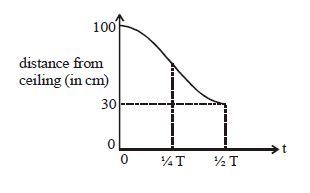
- 10A spring hangs vertically from the ceiling and a mass is attached to its free end. When the mass is pulled down and released, it oscillates vertically with simple harmonic motion of period $T$ . The variation with time $t$ of its distance from the ceiling is as shown. Which statement gives a correct deduction from this graph?View Solution