MCQ
A particle is projected from a horizontal plane ($x-z$ plane) such that its velocity vector at time t is given by $\vec V = a\hat i + (b - ct)\hat j$ Its range on the horizontal plane is given by
  • A
    $\frac{{ba}}{c}$
  • $\frac{{2ba}}{c}$
  • C
    $\frac{{3ba}}{c}$
  • D
    None

Answer

Correct option: B.
$\frac{{2ba}}{c}$
b
$\vec{v}=a i+(b-c i) j$

$\Rightarrow \quad v_{x}=a \quad v_{y}=b-c t$

$a_{y}=\frac{d v_{y}}{d t}=-c$

$R=\frac{2 u_{x} u_{y}}{a_{y}} \Rightarrow R=\frac{2 a  b}{c}$

Need a full question paper?

Generate a complete, print-ready paper with questions like this in minutes — across 16+ boards, with answer keys.

Start Generating Free

Similar questions

The mean time period of second's pendulum is $2.00s$ and mean absolute error in the time period is $0.05s$. To express maximum estimate of error, the time period should be written as
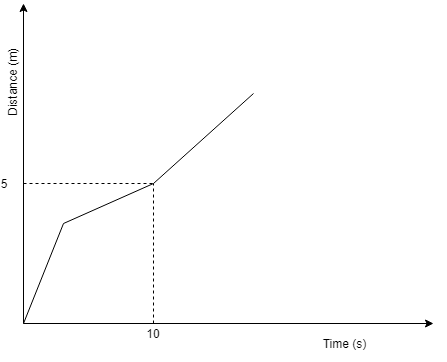
What is the velocity for a body following the graph below at $10s?$
Two plates $A$ and $B$ have thermal conductivities $84\,Wm ^{-1}\,K ^{-1}$ and $126\,Wm ^{-1}\,K ^{-1}$ respectively. They have same surface area and same thickness. They are placed in contact along their surfaces. If the temperatures of the outer surfaces of $A$ and $B$ are kept at $100^{\circ}\,C$ and $0{ }^{\circ}\,C$ respectively, then the temperature of the surface of contact in steady state is $..........\,{ }^{\circ} C$.
Work done by gravitational force in one revolution of the earth around the sun on its elliptical path is zero because:
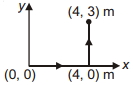
A force $\vec{F}=(3 \vec{i}+4 \vec{j}) \;N$ acts on a particle moving in $x-y$ plane. Starting from origin, the particle first goes along $x$-axis to the point $(4,0) \,m$ and then parallel to the $y$-axis to the point $(4,3) \,m$. The total work done by the force on the particle is ............. $J$
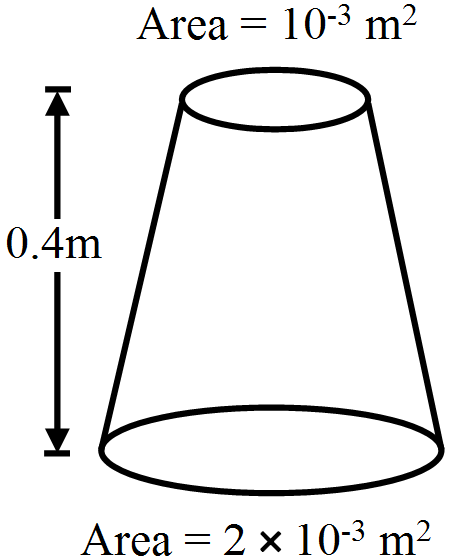
A uniformly tapering vessel is filled with a liquid of density $900\ kgm^{-3}$. The force that acts on the base of the vessel due to the liquid is $($Take, $g = 10\ ms^{-2})$​​​​​​​​​​​​​​
As observed from earth, the sun appears to move in an approximate circular orbit. For the motion of another planet like mercury as observed from earth, this would.
In which of the following gas the root mean square velocity will be minimum (at const. temperature)
A particle of mass $\mathrm{m}$ is projected with a speed $u$ from the ground at an angle $\theta=\frac{\pi}{3}$ w.r.t. horizontal ($x-$axis). When it has reached its maximum height, it collides completely inelastically with another particle of the same mass and velocity $u \hat i$. The horizontal distance covered by the combined mass before reaching the ground is
If velocity of particle moving along $x-$ axis is given as $v = k\sqrt x $ . Then ($a$ is acceleration)