- A$\frac{\upsilon }{2}\sqrt {1 + 2\,\,{{\cos }^{2\,}}\theta } $
- B$\frac{\upsilon }{2}\sqrt {1 + {{\cos }^{2\,}}\theta } $
- ✓$\frac{\upsilon }{2}\sqrt {1 + 3\,\,{{\cos }^{2\,}}\theta } $
- D$\upsilon \,\cos \,\theta $
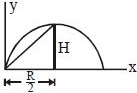
$v_{w_{w}}=\frac{\sqrt{H^{2}+\frac{R^{2}}{4}}}{T / 2}$
Here, $\quad \mathrm{H}=$ maximum height $=\frac{v^{2} \sin ^{2} \theta}{2 g}$
$\mathrm{R}=\mathrm{range}=\frac{\mathrm{v}^{2} \sin 2 \theta}{\mathrm{g}}$
and $\quad \mathrm{T}=$ time of flight $=\frac{2v \sin \theta}{\mathrm{g}}$
$\therefore \quad \mathrm{U}_{\mathrm{av} .}=\frac{\mathrm{v}}{2} \sqrt{1+3 \cos ^{2} \theta}$
Generate a complete, print-ready paper with questions like this in minutes — across 16+ boards, with answer keys.
$S1:$ The efficiency of a heat engine can be $1,$ but the coefficient of performance of a refrigerator can never be infinity.
$S2:$ The first law of thermodynamics is basically the principle of conservation of energy.
$S3:$ The second law of thermodynamics does not allow several phenomena consistent with the first law.
$S4:$ A process,whose only result is to transfer heat from a colder to a hotter object, is impossible.