Question
A particle is projected with a speed u at an angle $\theta$ with the horizontal. Consider a small part of its path near the highest position and take it approximately to be a circular arc. What is the radius of this circle? This radius is called the radius of curvature of the curve at the point.

Answer


Particle is projected with speed ‘u’ at an angle $\theta.$ At the highest pt. the vertical component of velocity is‘0’.
So, at that point, velocity $=\text{u}\sin\theta$
centripetal force $=\text{mu}^2\cos^2\Big(\frac{\theta}{\text{r}}\Big)$
At highest pt.
$\text{mg}=\frac{\text{mv}^2}{\text{r}}$
$\Rightarrow\text{r}=\frac{\text{u}^2\cos^2\theta}{\text{g}}$

Need a full question paper?

Generate a complete, print-ready paper with questions like this in minutes — across 16+ boards, with answer keys.

Start Generating Free

Similar questions

A body is moving in a straight line along $x-$axis. Its distance from the origin is given by the equation $x = at^2 - bt^3$, where $x$ is in metre and $t$ is in second. Find :
  1. The average speed of the body in the interval $t = 0$ and $t = 2s$.
  2. its instantaneous speed at $t = 2s$.
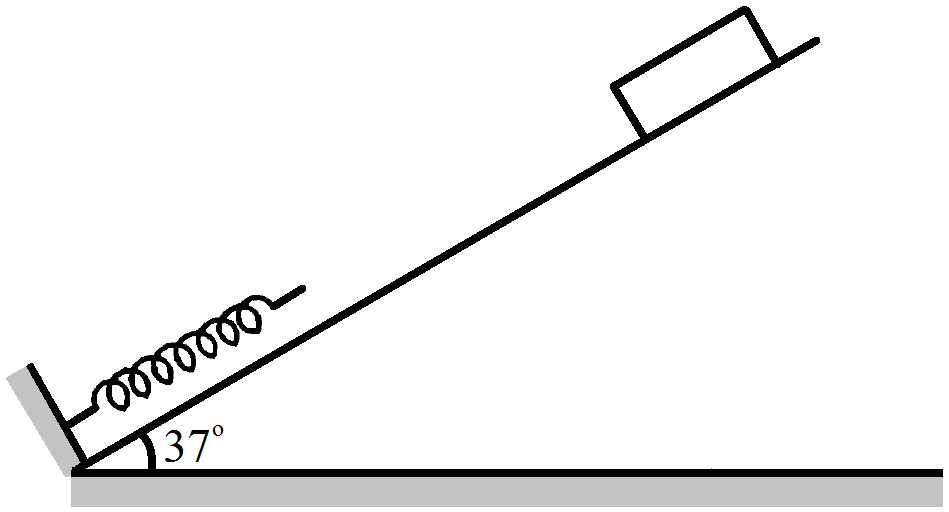
Figure shows a spring fixed at the bottom end of an incline of inclination $37^\circ$. A small block of mass 2kg starts slipping down the incline from a point 4.8m away from the spring. The block compresses the spring by 20cm, stops momentarily and then rebounds through a distance of 1m up the incline. Find.
  1. The friction coefficient between the plane and the block.
  2. The spring constant of the spring. Take $g = 10m/s^2.$
Why the molecular motion of the molecules ceases at zero kelvin?
Consider a simple pendulum, having a bob attached to a string, that oscillates under the action of the force of gravity. Suppose that the period
of oscillation of the simple pendulum depends on its length $(l),$ mass of the bob $(m)$ and acceleration due to gravity $(g)$. Derive the expression for its time period using method of dimensions.
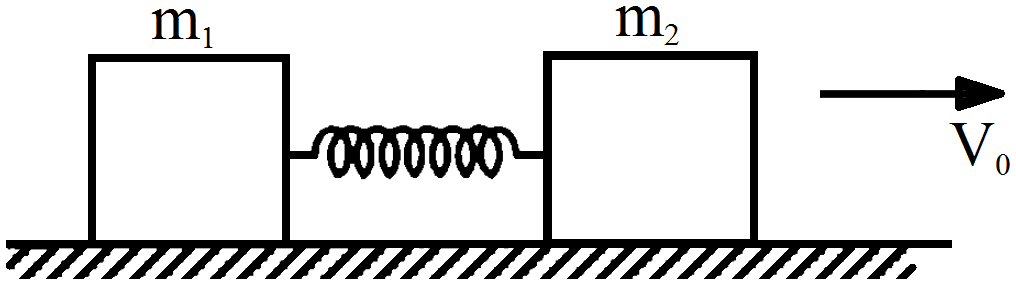
Two blocks of masses $m_1$ and $m_2$ are connected by a spring of spring constant k. The block of mass $m_2$ is given a sharp impulse so that it acquires a velocity $v_0$ towards right. Find
  1. The velocity of the centre of mass.
  2. The maximum elongation that the spring will suffer.
​​​​​​​
A rope of negligible mass is wound round a hollow cylinder of mass 3kg and radius $40cm$. What is the angular acceleration of the cylinder if the rope is pulled with a force of $30N$? What is the linear acceleration of the rope? Assume that there is no slipping.
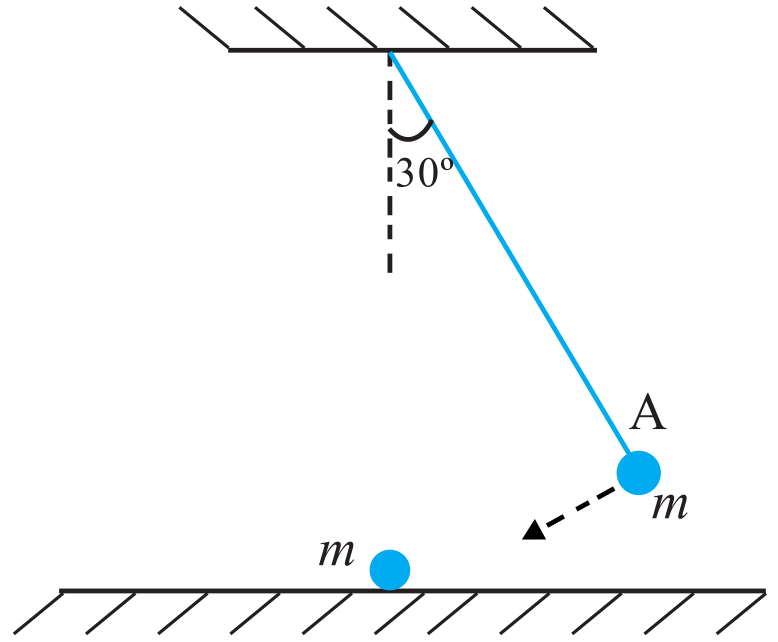
The bob A of a pendulum released from 30° to the vertical hits another bob B of the same mass at rest on a table as shown in. How high does the bob A rise after the collision? Neglect the size of the bobs and assume the collision to be elastic.
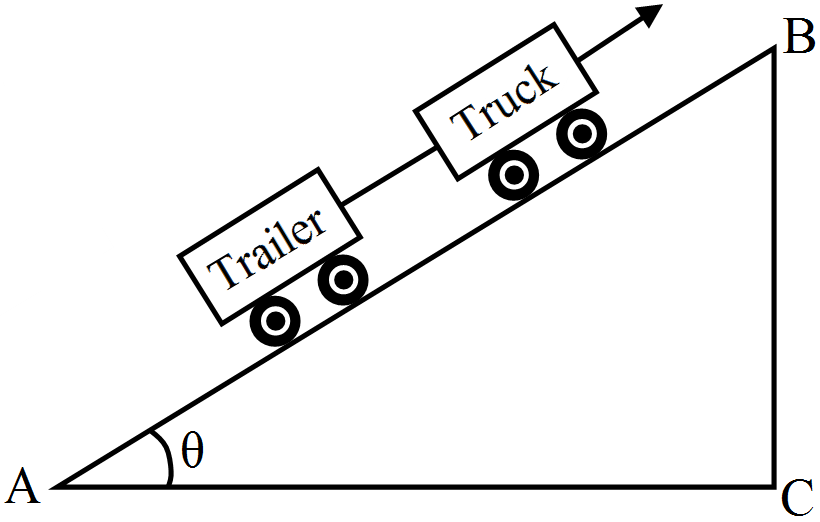
A truck tows a trailer of mass $1200kg$ at a speed of $10ms^{-1} $ on a level road. The tension in the coupling is $1000N$. What is the power extended on the trailer? Find the tension in the coupling when the truck ascends a road having an inclination of $1$ in $6$. Assume that the frictional resistance on the inclined plane is the same as that on the level road.
If the earth has a mass nine times and radius twice that of the planet Mars, calculate the maximum velocity required by a rocket to pull out of the gravitational force of Mars. Given escape velocity on the surface of earth is $11.2km/sec$.
Show that the total linear momentum of an isolated system of interacting particles is conserved.