MCQ
A particle is tied to $20\, cm$ long string. It performs circular motion in vertical plane. What is the angular velocity of string when the tension in the string at the top is zero  ........ $rad/sec$
  • A
    $5$
  • B
    $2$
  • C
    $7.5$
  • $7$

Answer

Correct option: D.
$7$
d
$\omega  = \sqrt {\frac{g}{r}}  = \sqrt {\frac{{9.8}}{{0.2}}}  = 7\,rad/\sec $

Need a full question paper?

Generate a complete, print-ready paper with questions like this in minutes — across 16+ boards, with answer keys.

Start Generating Free

Similar questions

A rod is placed on a smooth horizontal surface. The stress developed when temperature is increased by $40\,^oC$

$[\alpha = 5\, \times\, 10^{-5}\,^oC^{-1},\,\, \gamma = 5\, \times\, 10^{11}\,\, N/m^2]$
The velocity of a body at time $ t = 0$ is $10\sqrt 2 \,m/s$ in the north-east direction and it is moving with an acceleration of $ 2 \,m/s^{2}$ directed towards the south. The magnitude and direction of the velocity of the body after $5\, sec$ will be
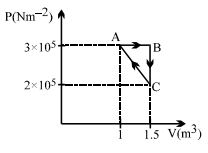
Considere the thermodynamics cycle shown on $PV$ diagram. The process $A \rightarrow B$ is isobaric, $B \rightarrow C$ is isochoric and $C \rightarrow A$ is a straight line process. The following internal energy and heat are given $: \Delta U_{A \rightarrow B} = + 400\,\, kJ$ and $Q_{B \rightarrow C} = - 500\,\, kJ$ The heat flow in the process $Q_{C \rightarrow A}$ is  ...... $kJ$
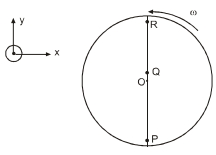
Consider a disc rotating in the horizontal plane with a constant angular speed $\omega$ about its centre $O$. The disc has a shaded region on one side of the diameter and an unshaded region on the other side as shown in the figure. When the disc is in the orientation as shown, two pebbles $P$ and $Q$ are simultaneously projected at an angle towards $R$. The velocity of projection is in the $y$-z plane and is same for both pebbles with respect to the disc. Assume that $(i)$ they land back on the disc before the disc completed $\frac{1}{8}$ rotation. $(ii)$ their range is less than half disc radius, and $(iii)$ $\omega$ remains constant throughout. Then
A physical quantity is $A = P^2/Q^3.$ The percentage error in measurement of $P$ and $Q$ is $x$ and $y$ respectively. Maximum error in measurement of $A$ is
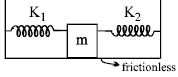
Two springs with negligible masses and force constant of $K_1 = 200\, Nm^{-1}$ and $K_2 = 160\, Nm^{-1}$ are attached to the block of mass $m = 10\, kg$ as shown in the figure. Initially the block is at rest, at the equilibrium position in which both springs are neither stretched nor compressed. At time $t = 0,$ a sharp impulse of $50\, Ns$ is given to the block with a hammer.
One mole of ideal gas required 207J heat to rise the temperature by 10°K when heated at constant pressure. If the same gas is heated at constant volume to raise the temperature by the same 10°K the heat required is (R = 8/ 3J/ mole°K)
Two capillary of length $L $ and $2L$  and of radius $R$  and $2R$  are connected in series. The net rate of flow of fluid through them will be (given rate of the flow through single capillary, $X = \pi P{R^4}/8\eta L)$
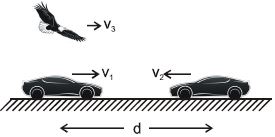
A bird flies to and fro between two cars which move with velocity $v_1 = 20\, m/s$ and $v_2 = 30\, m/s$. If the speed of the bird is $v_3 = 10\, m/s$ and the initial distance of  separation between them is $d = 2\, km$, find the total distance covered by the bird till  the cars meet.........$m$
A metallic ball and highly stretched spring are made of the same material and have the same mass. They are heated so that they melt, the latent heat required