MCQ
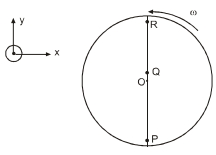
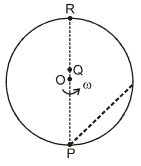
Consider a disc rotating in the horizontal plane with a constant angular speed $\omega$ about its centre $O$. The disc has a shaded region on one side of the diameter and an unshaded region on the other side as shown in the figure. When the disc is in the orientation as shown, two pebbles $P$ and $Q$ are simultaneously projected at an angle towards $R$. The velocity of projection is in the $y$-z plane and is same for both pebbles with respect to the disc. Assume that $(i)$ they land back on the disc before the disc completed $\frac{1}{8}$ rotation. $(ii)$ their range is less than half disc radius, and $(iii)$ $\omega$ remains constant throughout. Then
  • A
    $P$ lands in the shaded region and $Q$ in the unshaded region
  • B
    $P$ lands in the unshaded region and $Q$ in the shaded region
  • Both $P$ and $Q$ land in the unshaded region
  • D
    Both $P$ and $Q$ land in the shaded region
Answer

Correct option: C.
Both $P$ and $Q$ land in the unshaded region
c
Since distance of particle $P$ from point $O$ is initially decreasing then increasing so, its angular velocity $w$ initially increase then decrease. So, angle swept by $P$ is more than angle swept by disc. So it will fall unshaded portion.

Since distance of particle $Q$ from $O$ is continuously increasing so its $\omega$ is continuously decreasing. So ang swept by $Q$ is less than angle swept by disc. So it will fall in unshaded portion.

Need a full question paper?

Generate a complete, print-ready paper with questions like this in minutes — across 16+ boards, with answer keys.

Start Generating Free

Similar questions

A plane progressive wave is given by $y=2 \cos 2 \pi(330 t-x) m$. The frequency of the wave is:
Karman line is a theoretical construct that separates the earth's atmosphere from outer space. It is defined to be the height at which the lift on an aircraft flying at the speed of a polar satellite $(8 \,km / s )$ is equal to its weight. Taking a fighter aircraft of wing area $30 \,m ^2$, and mass $7500 \,kg$, the height of the Karman line above the ground will be in the range .............. $km$ (assume the density of air at height $h$ above ground to be $\rho( h )=1.2 e ^{\frac{ h }{10}} \,kg / m ^3$ where $h$ is in $km$ and the lift force to be $\frac{1}{2} \rho v^2 A$, where $v$ is the speed of the aircraft and $A$ its wing area).
A particle is kept at rest at a distance Re (earth's radius) above the earth's surface. The minimum speed with which it should be projected so that it does not return is (mass of earth = Me)
A thin piece of thermal conductor of constant thermal conductivity insulated on the lateral sides connects two reservoirs which are maintained at temperatures $T_{1}$ and $T_{2}$ as shown in the figure alongside. Assuming that the system is in steady state, which of the following plots best represents the dependence of the rate of change of entropy on the ratio of $T_{1} / T_{2}$ ?
The total kinetic energy of $1$ mole of oxygen at $27^{\circ} \mathrm{C}$ is :

[Use universal gas constant $(R)=8.31 \mathrm{~J} / \mathrm{mole} \mathrm{K}$ ]

Values of the acceleration $A$ of a particle moving in simple harmonic motion as a function of its displacement $x$ are given in the table below. The period of the motion is

$A (mm \,\,s^{-2}$)

 $16$

    $8$

$0$

$- 8$

$- 16$

$x\;(mm)$

$- 4$

$- 2$

$0$

  $2$

   $4$

A projectile is thrown at an angle '$\theta '$ to the horizontal from $O$ and it hits the ground at $O'$. During the entire motion (select the wrong statement)
The maximum horizontal range of a projectile is $400\;m$.The maximum height atteined by it?
A mass is performing vertical circular motion (see figure). If The average velocity of the particle is increased, then at which point the string will break
Let W be the work done, when a bubble of volume V is formed from a give solution. How much work is required to be done to form a bubble of volume 2V?