MCQ
A particle is tied to $20\, cm$ long string. It performs circular motion in vertical plane. What is the angular velocity of string when the tension in the string at the top is zero  ........ $rad/sec$
  • A
    $5$
  • B
    $2$
  • C
    $7.5$
  • $7$

Answer

Correct option: D.
$7$
d
$\omega  = \sqrt {\frac{g}{r}}  = \sqrt {\frac{{9.8}}{{0.2}}}  = 7\,rad/\sec $

Need a full question paper?

Generate a complete, print-ready paper with questions like this in minutes — across 16+ boards, with answer keys.
Start Generating Free

Similar questions

A copper and a steel wire of the same diameter are connected end to end. A deforming force F is applied to this composite wire which causes a total elongation of 1cm. The two wires will have
  1. The same stress.
  2. Different stress.
  3. The same strain.
  4. Different strain.
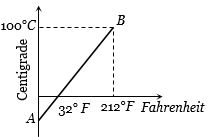
The graph $AB$ shown in figure is a plot of temperature of a body in degree celsius and degree Fahrenheit. Then
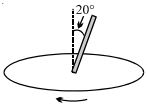
$A$ uniform rod is fixed to a rotating turntable so that its lower end is on the axis of the turntable and it makes an angle of $20^o$ to the vertical. (The rod is thus rotating with uniform angular velocity about a vertical axis passing through one end.) If the turntable is rotating clockwise as seen from above. Is there a torque acting on it, and if so in what direction?
The general displacement of a simple harmonic oscillator is $x = A \sin \omega t$. Let $T$ be its time period. The slope of its potential energy (U) - time (t) curve will be maximum when $t=\frac{T}{\beta}$. The value of $\beta$ is $.........$
A block is attached to a spring as shown and very-very gradually lowered so that finally  spring expands by $"d"$. If same block is attached to spring & released suddenly then maximum expansion in spring will be-
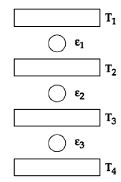
Three Carnot engines operate in series between a heat source at a temperature $T_1$ and a heat sink at temperature $T_4$ (see figure). There are two other reservoirs at temperature $T_2$ and $T_3$, as shown, with $T_1 > T_2 > T_3 > T_4$. The three engines are equally efficient if
This question has statement $1$ and statement $2$ . Of the four choices given after the statements, choose the one that best describes the two statements. 
Statement $- 1$: A point particle of mass m moving with speed $u$ collides with stationary point particle of mass $M$. If the maximum energy loss possible is given as $f$ $\left( {\frac{1}{2}m{v^2}} \right)$ then $ f = \left( {\frac{m}{{M + m}}} \right)$ 

Statement $-2$: Maximum energy loss occurs when the particles get stuck together as a result of the collision.

Orbital velocity of earth's satellite near the surface is $7 \,km/s$. When the radius of the orbit is $4$ times than that of earth's radius, then orbital velocity in that orbit is ......... $km/sec$
If the earth were to cease rotating about its own axis. The increase in the value of $g$ in $C.G.S.$ system at a place of latitude of $45^o$ will be ........  $cm/sec^{2}$.
Two satellites of masses ${m_1}$ and ${m_2}({m_1} > {m_2})$ are revolving round the earth in circular orbits of radius ${r_1}$ and ${r_2}({r_1} > {r_2})$ respectively. Which of the following statements is true regarding their speeds ${v_1}$ and ${v_2}$ ?