MCQ
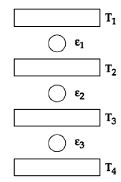
Three Carnot engines operate in series between a heat source at a temperature $T_1$ and a heat sink at temperature $T_4$ (see figure). There are two other reservoirs at temperature $T_2$ and $T_3$, as shown, with $T_1 > T_2 > T_3 > T_4$. The three engines are equally efficient if
  • A
    ${T_2} = {\left( {{T_1}{T_4}} \right)^{1/2}};\,{T_3} = {\left( {T_1^2{T_4}} \right)^{1/3}}$
  • ${T_2} = {\left( {T_1^2{T_4}} \right)^{1/3}};\,{T_3} = {\left( {{T_1}T_4^2} \right)^{1/3}}$
  • C
    ${T_2} = {\left( {{T_1}T_4^2} \right)^{1/3}};\,{T_3} = {\left( {T_1^2{T_4}} \right)^{1/3}}$
  • D
    ${T_2} = {\left( {T_1^3{T_4}} \right)^{1/4}};\,{T_3} = {\left( {{T_1}T_4^3} \right)^{1/4}}$
Answer

Correct option: B.
${T_2} = {\left( {T_1^2{T_4}} \right)^{1/3}};\,{T_3} = {\left( {{T_1}T_4^2} \right)^{1/3}}$
b
$n_{1}=n_{2}=n_{3}$

$\Rightarrow \quad 1-\frac{T_{2}}{T_{1}}=1-\frac{T_{3}}{T_{2}}=1-\frac{T_{4}}{T_{3}}$

$\Rightarrow \quad \frac{T_{2}}{T_{1}}=\frac{T_{3}}{T_{2}}=\frac{T_{4}}{T_{3}}$

$\Rightarrow \quad \mathrm{T}_{2} \mathrm{T}_{3}=\mathrm{T}_{1} \mathrm{T}_{4}$ and $\frac{\mathrm{T}_{3}^{2}}{\mathrm{T}_{2}}=\mathrm{T}_{4}$

Solve for $\mathrm{T}_{2}$ and $\mathrm{T}_{3}$

Need a full question paper?

Generate a complete, print-ready paper with questions like this in minutes — across 16+ boards, with answer keys.

Start Generating Free

Similar questions

Change of state from solid to vapour state without passing through the liquid state is called:
As shown in the figure, a bob of mass $\mathrm{m}$ is tied by a massless string whose other end portion is wound on a fly wheel (disc) of radius $\mathrm{r}$ and mass $m$. When released from rest the bob starts falling vertically. When it has covered a distance of $h$. the angular speed of the wheel will be
A monoatomic gas of $n-$moles is heated from temperature $T‌_1$ to $T_2$ under two different conditions $(i)$ at constant volume and $(ii)$ at constant pressure. The change in internal energy of the gas is
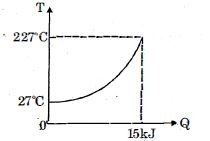
$Q$ amount of heat is given to $0.5\  mole$ of an ide al mono-atomic gas by a process $TV^n$  constant. Following graph shows variation of temperature with $Q$ . Find value of $n$.
A missile is fired for maximum range at your town from a place $100\, km$ away from you. If the missile is first detected at its half way point, how much warning time will you have ? (Take $g = 10\, m/s^2$) what was the speed of missile when it was detected ?
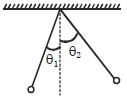
Two masses, both equal to $100\, g$, are suspended at the ends of identical light strings of length $\lambda = 1.0\, m$, attached to the same point on the ceiling (see figure). At time $t = 0$, they are simultaneously released from rest, one at angle $\theta_1 = 1^o$, the other at angle $\theta_2 = 2^o$ from the vertical. The masses will collide
A train moves from rest with a uniform acceleration $a$ . Attaining a maximum speed $v$ it  starts moving with uniform retardation $a$ . Assuming $s$ = total distance covered in the  unidirectional motion of the train, its total time of journey and maximum speed are  (respectively).
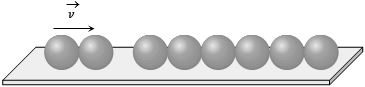
Six identical balls are lined in a straight groove made on a horizontal frictionless surface as shown. Two similar balls each moving with a velocity $v$ collide elastically with the row of $6$ balls from left. What will happen
The velocity and acceleration vectors of a particle undergoing circular motion are $\overrightarrow{ v }=2 \hat{ i } m / s$ and $\overrightarrow{ a }=2 \hat{ i }+4 \hat{ j } m / s ^2$ respectively at an instant of time. The radius of the circle is $........\,m$
Two waves of lengths $50 \;cm$ and $51\; cm$ produced $12$ beats per second. The velocity of sound is .... $m/s$