MCQ
A particle moves along the $X-$axis as $x = u(t - 2s) + a(t - 2s)^2.$
  • A
    The initial velocity of the particle is $u.$
  • B
    The accelerati? $n $ of the particle is $a.$
  • The acceleration of the particle is $2a.$
  • D
    At $t = 2s$ particle is at the origin.
Answer

Correct option: C.
The acceleration of the particle is $2a.$
Initial velocity $=\Big|\frac{\text{dx}}{\text{dt}}\Big|_{\text{t} = 0}$
$\frac{\text{dx}}{\text{dt}}=\text{u}+2\text{a}(\text{t}-2\text{s})$
$\Big|\frac{\text{dx}}{\text{dt}}\Big|_{\text{t}=0}=\text{u}-4\ \text{as}\neq\text{u}$
Acceleration $=\frac{\text{d}^2\text{x}}{\text{dt}^2}=2\text{a}$
At $t = 2s,$
$x = u(2s - 2s) + a(2s - 2s)^2 = 0 ($origin$)$

Need a full question paper?

Generate a complete, print-ready paper with questions like this in minutes — across 16+ boards, with answer keys.

Start Generating Free

Similar questions

Identify the type of materials which develop electric currents in them, when an electric field is applied.
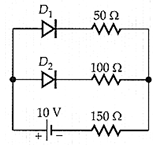
Assume that each diode shown in the figure has a forward bias resistance of $50 \Omega$ and an infinite reverse bia resistance. The current through the $150 \Omega$ resistance is
Image
It is desired to photograph the image of an object placed at a distance of 3m from the plane mirror. The camera which is at a distance of 4.5 m  from the mirror should be focussed for a distance of(a) 3m(b) 4.5m(c) 6m(d) 7.5 m
       
Which of the following gates will have an output of $1$
Which among the following is denoted by $\delta$?
The binding energy per nucleon of $o^{16}$ is $7.97\ MeV$ and that of $O^{17}$ is $7.75\ MeV.$ The energy $($in $MeV)$  required to remove a neutron from $O^{17}$ is
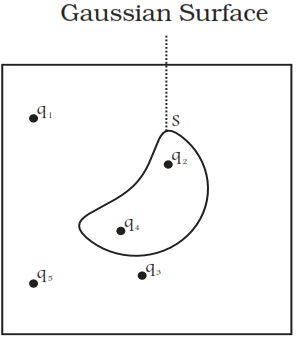
Five charges $q_1, q_2, q_3, q_4,$ and $q_5$ are fixed at their positions as shown in. $S$ is a Gaussian surface. The Gauss’s law is given by$\oint\limits_\text{S}\text{E.ds}=\frac{\text{q}}{\epsilon_0}$ Which of the following statements is correct?
The motion of a particle is given by $\text{x = A}\sin\omega\text{t+B}\cos\omega\text{t}.$ The motion of the particle is:
  1. Not simple harmonic.
  2. Simple harmonic with amplitude A + B.
  3. Simple harmonic with amplitude $\frac{\text{(A}+\text{B)}}{2}.$
  4. Simple harmonic with amplitude $\sqrt{(\text{A}^2+\text{B}^2)}.$
A short magnet oscillates with a time period 0.1 s at a place where horizontal magnetic field is 24μT. A downward current of 18 A is established in a vertical wire 20 cm east of the magnet. The new time period of oscillator(a) 0.1 s(b) 0.089 s(c) 0.076 s(d) 0.057 s
       
Find the odd one out.