MCQ
A particle moves along the X-axis as x = u(t - 2s) + a(t - 2s)2.
  • A
    The initial velocity of the particle is u.
  • B
    The accelerati?n of the particle is a.
  • C
    The acceleration of the particle is 2a.
  • D
    At t = 2s particle is at the origin.

Answer

  1. The acceleration of the particle is 2a.
  2. At t = 2s particle is at the origin.

Explanation:

Initial velocity $=\Big|\frac{\text{dx}}{\text{dt}}\Big|_{\text{t} = 0}$

$\frac{\text{dx}}{\text{dt}}=\text{u}+2\text{a}(\text{t}-2\text{s})$

$\Big|\frac{\text{dx}}{\text{dt}}\Big|_{\text{t}=0}=\text{u}-4\text{as}\neq\text{u}$

Acceleration $=\frac{\text{d}^2\text{x}}{\text{dt}^2}=2\text{a}$

At t = 2s,

x = u(2s - 2s) + a(2s - 2s)2 = 0 (origin)

Need a full question paper?

Generate a complete, print-ready paper with questions like this in minutes — across 16+ boards, with answer keys.
Start Generating Free

Similar questions

A block of mass $1\, kg$ is at rest on a horizontal table. The coefficient of static friction  between the block and the table is $0.5.$ The magnitude of the force acting upwards at  an angle of $60^o$ from the horizontal that will just start the block moving is
With increase in temperature, the viscosity of:
  1. Gases decreases.
  2. Liquids increases.
  3. Gases increases.
  4. liquids decreases.
If the density of oxygen is $16$ times that of hydrogen, what will be the ratio of their corresponding velocities of sound waves
Maximum density of ${H_2}O$ is at the temperature  .......... $^oF$ 
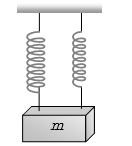
A mass $m$ is suspended separately by two different springs of spring constant $K_1$ and $K_2$ gives the time-period ${t_1}$ and ${t_2}$ respectively. If same mass $m$ is connected by both springs as shown in figure then time-period $t$ is given by the relation
You are on a frictionless horizontal plane. How can you get off if no horizontal force is exerted by pushing against the surface
For a given velocity, a projectile has the same range $R$ for two angles of projection if $t_1$ and $t_2$ are the times of flight in the two cases then
A ball of mass 0.2kg is thrown vertically upwards by applying a force by hand. If the hand moves 0.2m which applying the force and the ball goes upto 2m height further, find the magnitude of the force. Consider g = 10m/ s2
A particle revolves round a circular path. The acceleration of the particle is
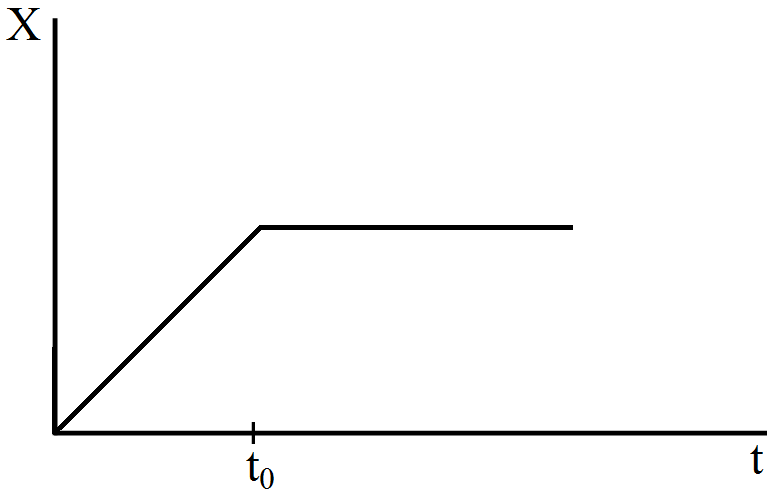
Figure shows the displacement-time graph of a particle moving on the X-axis.