Question
A particle moves in a circular path with a continuously increasing speed. Its motion is:
  1. Periodic.
  2. Oscillatory.
  3. Simple harmonic.
  4. None of them.

Answer

  1. None of them.

Explanation:

As the particle does not complete one rotation in a fixed interval of time, neither does it oscillate around a mean position.

Need a full question paper?

Generate a complete, print-ready paper with questions like this in minutes — across 16+ boards, with answer keys.
Start Generating Free

Similar questions

If the angular momentum of a planet of mass $m$, moving a round the Sun in a circular orbit its $L$, about the center of the Sun, its areal velocity is
The equation of a wave is given by (all quantity expressed in $m.k.s\ units$ ) $Y$ = $5\ sin10\pi $ $(t - 0.01x)$ along the $x-$ axis. The phase difference between the points separated by a distance of $10\ m$ along $x-$ axis is
A vertical rod AC, with C at ground and A being the top most point is moving in such a way, that A moves with a speed of 8 m/ s, mid point of the rod B moves with a speed of 4 m/ s. along the same direction, with what velocity will the point C move:
$0.1\,m^3$ of water at $80\,^oC$ is mixed with $0.3\,m^3$ of water at $60\,^oC$. The final temperature of the mixture is ........ $^oC$
An angular impulse of $20 \,Nms$ is applied to a hollow cylinder of mass $2 \,kg$ and radius $20 \,cm$. The change in its angular speed is ............. $rad / s$
A particle executes linear simple harmonic motion with an ampilitude of $3\,cm$ . When the particle is at $2\,cm$ from the mean position , the magnitude of its velocity is equal to that of its acceleration. Then its time period in seconds is 
The energy spectrum of a black body exhibits a maximum around a wavelength ${\lambda _o}.$ The temperature of the black body is now changed such that the energy is maximum around a wavelength $\frac{{3{\lambda _o}}}{4}$.The power radiated by the black body will now increase by a factor of
$A$ current of $(2.5 \pm 0.05)$ $A$ flows through a wire and develops a potential difference of $(10 \pm 0.1)$ $\mathrm{volt}.$ Resistance of the wire in $\mathrm{ohm},$ is
Oxygen is $16$ times heavier than hydrogen. Equal volumes of hydrogen and oxygen are mixed. The ratio of speed of sound in the mixture to that in hydrogen is
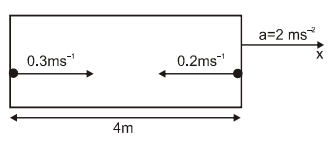
A rocket is moving in a gravity free space with a constant acceleration of $2 \ ms ^{-2}$ along $+x$ direction (see figure). The length of a chamber inside the rocket is $4 \ m$. A ball is thrown from the left end of the chamber in $+x$ direction with a speed of $0.3 \ ms ^{-1}$ relative to the rocket. At the same time, another ball is thrown in $-x$ direction with a speed of $0.2 \ ms ^{-1}$ from its right end relative to the rocket. The time in seconds when the two balls hit each other is: