A particle moves in the $x-y$ plane according to equation $\overrightarrow r = (\widehat i + 2\widehat j)\, A \, \cos \omega t$. The motion of the particle is
Diffcult


Download our appand get started for free
Experience the future of education. Simply download our apps or reach out to us for more information. Let's shape the future of learning together!No signup needed.*
Similar Questions
- 1The length of simple pendulum is increased by $44\%$. The percentage increase in its time period will be ..... $\%$View Solution
- 2A particle executes simple hormonic motion between $x =\, -A$ and $x = +A$ . It starts from $x = 0$ moves in $+x-$ direction. The time taken for it to move from $x = 0$ to $x = \frac {A}{2}$ is $T_1$ and to move from $\frac {A}{2}$ to $\frac {A}{\sqrt 2}$ is $T_2$ , thenView Solution
- 3Aheavy brass sphere is hung from a light spring and is set in vertical small oscillation with a period $T.$ The sphere is now immersed in a non-viscous liquid with a density $1/10\,th$ the density of the sphere. If the system is now set in vertical $S.H.M.,$ its period will beView Solution
- 4A particle is performing simple harmonic motion with amplitude A and angular velocity ${\omega }$. The ratio of maximum velocity to maximum acceleration isView Solution
- 5A mass $M$ is suspended from a spring of negligible mass. The spring is pulled a little and then released so that the mass executes simple harmonic oscillations with a time period $T$. If the mass is increased by m then the time period becomes $\left( {\frac{5}{4}T} \right)$. The ratio of $\frac{m}{{M}}$ isView Solution
- 6A particle is performing simple harmonic motionView Solution
$(i)$ its velocity-displacement graph is parabolic in nature
$(ii)$ its velocity-time graph is sinusoidal in nature
$(iii)$ its velocity-acceleration graph is elliptical in nature
Correct answer is - 7pendulum made of a uniform wire of cross sectional area $A$ has time period $T$. When an additional mass $M$ is added to its bob, the time period changes to $T_M$. If the Young's modulus of the material of the wire is $Y$ then $\frac{1}{Y}$ is equal to : ($g$ = gravitational acceleration)View Solution
- 8View SolutionTwo oscillating systems; a simple pendulum and a vertical spring-mass-system have same time period of motion on the surface of the Earth. If both are taken to the moon, then-
- 9The maximum speed of a particle executing $S.H.M.$ is $1\,m/s$ and its maximum acceleration is $1.57\,m/se{c^2}$. The time period of the particle will be .... $\sec$View Solution
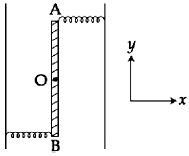
- 10Two light identical springs of spring constant $k$ are attached horizontally at the two ends of a uniform horizontal rod $AB$ of length $l$ and mass $m$. the rod is pivoted at its centre $‘O’$ and can rotate freely in horizontal plane. The other ends of the two springs are fixed to rigid supports as shown in figure. The rod is gently pushed through a small angle and released. The frequency of resulting oscillation isView Solution