A particle of mass $250\,g$ executes a simple harmonic motion under a periodic force $F =(-25\,x) N$. The particle attains a maximum speed of $4\,m / s$ during its oscillation. The amplitude of the motion is $...........cm$.
JEE MAIN 2023, Medium


Download our appand get started for free
Experience the future of education. Simply download our apps or reach out to us for more information. Let's shape the future of learning together!No signup needed.*
Similar Questions
- 1A spring mass system preforms $S.H.M.$ If the mass is doubled keeping amplitude same, then the total energy of $S.H.M.$ will become :View Solution
- 2The displacement y of a particle executing periodic motion is given by $y = 4{\cos ^2}(t/2)\sin (1000t)$. This expression may be considered to be a result of the superposition of ........... independent harmonic motionsView Solution
- 3When a mass $m$ is attached to a spring, it normally extends by $0.2\, m$. The mass $m$ is given a slight addition extension and released, then its time period will beView Solution
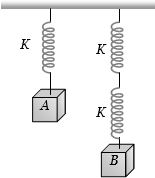
- 4The springs shown are identical. When $A = 4kg$, the elongation of spring is $1\, cm$. If $B = 6\,kg$, the elongation produced by it is ..... $ cm$View Solution
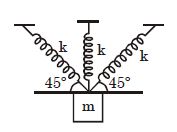
- 5Initially system is in equilibrium. Time period of $SHM$ of block in vertical direction isView Solution
- 6A body is executing simple harmonic motion with frequency $'n',$ the frequency of its potential energy is :View Solution
- 7View SolutionThe period of a simple pendulum is doubled, when
- 8View SolutionIf the metal bob of a simple pendulum is replaced by a wooden bob, then its time period will
- 9Two damped spring-mass oscillating systems have identical spring constants and decay times. However, system $A's$ mass $m_A$ is twice system $B's$ mass $m_B$ . How do their damping constants, $b$ , compare ?View Solution
- 10A particle is executing Simple Harmonic Motion $(SHM)$. The ratio of potential energy and kinetic energy of the particle when its displacement is half of its amplitude will beView Solution