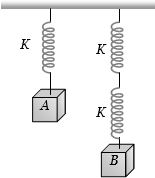
The springs shown are identical. When $A = 4kg$, the elongation of spring is $1\, cm$. If $B = 6\,kg$, the elongation produced by it is ..... $ cm$
Medium
Download our app for free and get started
b) $F = kx$
==> $mg = kx$
==> $m \propto kx$
Hence $\frac{{{m_1}}}{{{m_2}}} = \frac{{{k_1}}}{{{k_2}}} \times \frac{{{x_1}}}{{{x_2}}}$
==> $\frac{4}{6} = \frac{k}{{k/2}} \times \frac{1}{{{x_2}}}$
$ \Rightarrow {x_2} = 3\,cm$.

Download our appand get started for free
Experience the future of education. Simply download our apps or reach out to us for more information. Let's shape the future of learning together!No signup needed.*
Similar Questions
- 1View SolutionA simple pendulum is taken from the equator to the pole. Its period
- 2A simple pendulum is set up in a trolley which moves to the right with an acceleration a on a horizontal plane. Then the thread of the pendulum in the mean position makes an angle $\theta $ with the verticalView Solution
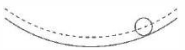
- 3A ball is rolling without slipping in a spherical shallow bowl (radius $R$ ) as shown in the figure and is executing simple harmonic motion. If the radius of the ball is doubled, then the time period of oscillationView Solution
- 4View SolutionTo show that a simple pendulum executes simple harmonic motion, it is necessary to assume that
- 5A block of mass $200\, g$ executing $SHM$ under the influence of a spring of spring constant $K=90\, N\,m^{-1}$ and a damping constant $b=40\, g\,s^{-1}$. The time elapsed for its amplitude to drop to half of its initial value is ...... $s$ (Given $ln\,\frac{1}{2} = -0.693$)View Solution
- 6A plate oscillated with time period $‘T’$. Suddenly, another plate put on the first plate, then time periodView Solution
- 7The potential energy of a particle executing S.H.M. is $ 2.5\, J$, when its displacement is half of amplitude. The total energy of the particle be .... $J$View Solution
- 8The equation of $S.H.M.$ is $y = a\sin (2\pi nt + \alpha )$, then its phase at time $t$ isView Solution
- 9A particle executes simple harmonic motion (amplitude $= A$) between $x = - A$ and $x = + A$. The time taken for it to go from $0$ to $A/2$ is ${T_1}$ and to go from $A/2$ to $A$ is ${T_2}$. ThenView Solution
- 10A circular disc of mass $10 \;kg$ is suspended by a wire attached to its centre. The wire is twisted by rotating the disc and released. The period of torsional oscillations is found to be $1.5 \;s$. The radius of the disc is $15\; cm .$ Determine the torsional spring constant of the wire in $N\;m\;rad^{-1}$. (Torsional spring constant $\alpha$ is defined by the relation $J=-\alpha \theta,$ where $J$ is the restoring couple and $\theta$ the angle of twist).View Solution