A particle of mass m is attached to a spring (of spring constant k) and has a natural angular frequency ${\omega _0}$ - An external force $F (t)$ proportional to $\cos \omega \,t((\omega \ne {\omega _0})$ is applied to the oscillator. The time displacement of the oscillator will be proportional to
AIEEE 2004, Medium


Download our appand get started for free
Experience the future of education. Simply download our apps or reach out to us for more information. Let's shape the future of learning together!No signup needed.*
Similar Questions
- 1A particle performs simple harmonic motion with amplitude $A$. Its speed is trebled at the instant that it is at a distance $\frac{{2A}}{3}$ from equilibrium position. The new amplitude of the motion isView Solution
- 2The displacement equation of a particle is $x = 3\sin 2t + 4\cos 2t.$ The amplitude and maximum velocity will be respectivelyView Solution
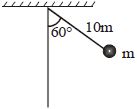
- 3View SolutionIf pendulum is released from given position find velocity of Bob when it reaches the lowest position
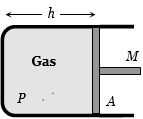
- 4A cylindrical piston of mass $M$ slides smoothly inside a long cylinder closed at one end, enclosing a certain mass of gas. The cylinder is kept with its axis horizontal. If the piston is disturbed from its equilibrium position, it oscillates simple harmonically. The period of oscillation will beView Solution
- 5Two pendulums have time periods $T$ and $5T/4.$ They start $SHM$ at the same time from the mean position. After how many oscillations of the smaller pendulum they will be again in the same phase :View Solution
- 6The total energy of a particle executing $S.H.M.$ is $80 \,J$. What is the potential energy when the particle is at a distance of $\frac{3}{4}$ of amplitude from the mean position..... $J$View Solution
- 7The kinetic energy of a particle executing $S.H.M.$ is $16\, J$ when it is at its mean position. If the mass of the particle is $0.32 \,kg$, then what is the maximum velocity of the particle ..... $m/s$View Solution
- 8Due to some force $F_1$ a body oscillates with period $4/5\, sec$ and due to other force $F_2$ oscillates with period $3/5\, sec$. If both forces act simultaneously, the new period will be .... $\sec$View Solution
- 9View SolutionThe frequency at which its kinetic energy change into potential energy is
- 10A spring executes $SHM$ with mass of $10\,kg$ attached to it. The force constant of spring is $10\,N/m$.If at any instant its velocity is $40\,cm/sec$, the displacement will be .... $m$ (where amplitude is $0.5\,m$)View Solution