A particle of mass $m$ is attached to one end of a mass-less spring of force constant $k$, lying on a frictionless horizontal plane. The other end of the spring is fixed. The particle starts moving horizontally from its equilibrium position at time $t=0$ with an initial velocity $u_0$. When the speed of the particle is $0.5 u_0$, it collies elastically with a rigid wall. After this collision :
$(A)$ the speed of the particle when it returns to its equilibrium position is $u_0$.
$(B)$ the time at which the particle passes through the equilibrium position for the first time is $t=\pi \sqrt{\frac{ m }{ k }}$.
$(C)$ the time at which the maximum compression of the spring occurs is $t =\frac{4 \pi}{3} \sqrt{\frac{ m }{ k }}$.
$(D)$ the time at which the particle passes througout the equilibrium position for the second time is $t=\frac{5 \pi}{3} \sqrt{\frac{ m }{ k }}$.
IIT 2013, Advanced
Download our app for free and get started
Displacement $x = A \sin \omega t$
Velocity $v = A \omega \cos \omega t =\frac{\omega A }{2}$
At the time of collision
$\cos \omega t=\frac{1}{2} $
$\omega t=\frac{\pi}{3} \Rightarrow t=\frac{2 \pi}{3}=\frac{\pi}{3} \sqrt{\frac{m}{k}}$
$Image$
for $(C)$ $ \quad time$$ =\frac{2 \pi}{3} \sqrt{\frac{m}{k}}+\frac{\pi}{2} \sqrt{\frac{m}{k}} $
$ =\frac{5 \pi}{6} \sqrt{\frac{m}{k}}$(So it is incorrect)
for $(D)$ $\quad time \quad=\frac{2 \pi}{3} \sqrt{\frac{m}{k}}+\pi \sqrt{\frac{m}{k}} $
$ =\frac{5 \pi}{3} \sqrt{\frac{m}{k}} \text { (So it is correct). }$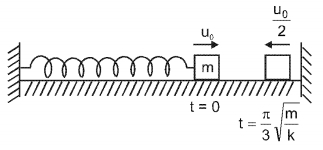

Download our appand get started for free
Experience the future of education. Simply download our apps or reach out to us for more information. Let's shape the future of learning together!No signup needed.*
Similar Questions
- 1Two simple harmonic motions, as shown, are at right angles. They are combined to form Lissajous figuresView Solution
$x\left( t \right) = A\,\sin \,\left( {at + \delta } \right)$
$y\left( t \right) = B\,\sin \,\left( {bt} \right)$
Identify the correct match below
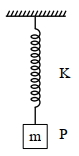
- 2In simple harmonic motion, the total mechanical energy of given system is E. If mass of oscillating particle $P$ is doubled then the new energy of the system for same amplitude is:View Solution
- 3A simple pendulum executing $S.H.M.$ is falling freely along with the support. ThenView Solution
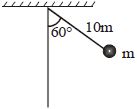
- 4View SolutionIf pendulum is released from given position find velocity of Bob when it reaches the lowest position
- 5View SolutionA simple pendulum is vibrating in an evacuated chamber, it will oscillate with
- 6The phase difference between two $SHM\,\,$ ${y_1}\, = \,10\,\sin \,\left( {10\pi t\, + \,\frac{\pi }{3}} \right)$ and ${y_2}\, = \,12\,\sin \,\left( {8\pi t\, + \,\frac{\pi }{4}} \right)$ at $t = 0.5\,s$ itView Solution
- 7Assume that a tunnel is dug along a chord of the earth, at a perpendicular distance $( R / 2)$ from the earth's centre, where $'R'$ is the radius of the Earth. The wall of the tunnel is frictionless. If a particle is released in this tunnel, it will execute a simple harmonic motion with a time periodView Solution
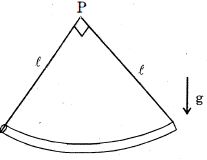
- 8A circular arc of mass $m$ is connected with the help of two massless strings as shown in the figuw in vertical plane. About point $P$, small oscillations are given in the plane of the arc. Time period of the oscillations of $SHM$ will beView Solution
- 9A point performs simple harmonic oscillation of period $T$ and the equation of motion is given by $x=Asin$$\left( {\omega t + \frac{\pi }{6}} \right)$. After the elapse of what fraction of the time period the velocity of the point will be equal to half of its maximum velocity?View Solution
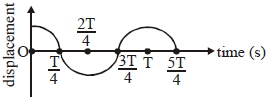
- 10The displacement time graph of a particle executing $S.H.M.$ is given in figure: (sketch is schematic and not to scale) Which of the following statements is are true for this motion?View Solution
$(A)$ The force is zero $t=\frac{3 T}{4}$
$(B)$ The acceleration is maximum at $t=T$
$(C)$ The speed is maximum at $t =\frac{ T }{4}$
$(D)$ The $P.E.$ is equal to $K.E.$ of the oscillation at $t=\frac{T}{2}$