A particle of mass m is hanging vertically by an ideal spring of force constant K. If the mass is made to oscillate vertically, its total energy is
Easy


Download our appand get started for free
Experience the future of education. Simply download our apps or reach out to us for more information. Let's shape the future of learning together!No signup needed.*
Similar Questions
- 1A $15 \,g$ ball is shot from a spring gun whose spring has a force constant of $600 \,N/m$. The spring is compressed by $5 \,cm$. The greatest possible horizontal range of the ball for this compression is .... $m$ ($g = 10 \,m/s^2$)View Solution
- 2View SolutionResonance is an example of
- 3A particle executes simple harmonic motion and is located at $x = a, b$ and $c$ at times $t_0, 2t_0$ and $3t_0$ respectively. The frequency of the oscillation isView Solution
- 4A simple pendulum is suspended from the roof of a trolley which moves in a horizontal direction with an acceleration $a$, then the time period is given by $T = 2\pi \sqrt {\frac{l}{{g'}}} $, where $g'$ is equal toView Solution
- 5An object of mass $0.2\, kg$ executes simple harmonic along $X-$ axis with frequency of $\frac{{25}}{\pi }Hz$. At the position $x = 0.04m$, the object has kinetic energy of $0.5 \,J$ and potential energy of $0.4\, J$ amplitude of oscillation in meter is equal toView Solution
- 6A body performs $S.H.M.$ Its kinetic energy $K$ varies with time $t$ as indicated by graphView Solution
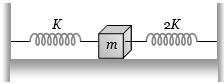
- 7Two springs of force constants $K$ and $2K$ are connected to a mass as shown below. The frequency of oscillation of the mass isView Solution
- 8A particle executing $SHM$ of amplitude $4\,cm$ and $T = 4s.$ The time taken by it to move from $+2\,cm$ to $+2\sqrt 3\,cm$ isView Solution
- 9Two masses $M_{A}$ and $M_{B}$ are hung from two strings of length $l_{A}$ and $l_{B}$ respectively. They are executing SHM with frequency relation $f_{A}=2 f_{B}$, then relationView Solution
- 10The function of time representing a simple harmonic motion with a period of $\frac{\pi}{\omega}$ is :View Solution