A particle of mass $m$ is moving along a trajectory given by
$x = x_0 + a\, cos\,\omega_1 t$
$y = y_0 + b\, sin\,\omega_2t$
The torque, acing on the particle about the origin, at $t = 0$ is
$x = x_0 + a\, cos\,\omega_1 t$
$y = y_0 + b\, sin\,\omega_2t$
The torque, acing on the particle about the origin, at $t = 0$ is
JEE MAIN 2019, Diffcult


Download our appand get started for free
Experience the future of education. Simply download our apps or reach out to us for more information. Let's shape the future of learning together!No signup needed.*
Similar Questions
- 1A particle of mass $m$ is attached to one end of a mass-less spring of force constant $k$, lying on a frictionless horizontal plane. The other end of the spring is fixed. The particle starts moving horizontally from its equilibrium position at time $t=0$ with an initial velocity $u_0$. When the speed of the particle is $0.5 u_0$, it collies elastically with a rigid wall. After this collision :View Solution
$(A)$ the speed of the particle when it returns to its equilibrium position is $u_0$.
$(B)$ the time at which the particle passes through the equilibrium position for the first time is $t=\pi \sqrt{\frac{ m }{ k }}$.
$(C)$ the time at which the maximum compression of the spring occurs is $t =\frac{4 \pi}{3} \sqrt{\frac{ m }{ k }}$.
$(D)$ the time at which the particle passes througout the equilibrium position for the second time is $t=\frac{5 \pi}{3} \sqrt{\frac{ m }{ k }}$.
- 2The oscillation of a body on a smooth horizontal surface is represented by the equation $x= Acos$$\omega t$View Solution
where $x=$ displacement at time $t$
$\omega =$ frequency of oscillation
Which one of the following graphs shows correctly the variation $a$ with $t$ ?
Here $a=$ acceleration at time $t$
$T=$ time period
- 3The motion of a particle varies with time according to the relation $y = a(\sin \omega \,t + \cos \omega \,t)$, thenView Solution
- 4$Assertion :$ Resonance is a special case of forced vibration in which the natural frequency of vibration of the body is the same as the impressed frequency of external periodic force and the amplitude of forced vibration is maximum.View Solution
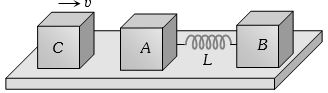
$Reason :$ The amplitude of forced vibrations of a body increases with an increase in the frequency of the externally impressed periodic force. - 5Two blocks $A$ and $B$ each of mass m are connected by a massless spring of natural length L and spring constant $K$. The blocks are initially resting on a smooth horizontal floor with the spring at its natural length as shown in figure. A third identical block $C$ also of mass $m$ moves on the floor with a speed $v$ along the line joining $A$ and $B$ and collides with $A$. ThenView Solution
- 6A mass $m$ attached to a spring oscillates with a period of $3\,s$. If the mass is increased by $1\,kg$ the period increases by $1\,s$. The initial mass $m$ isView Solution
- 7As a body performs $S.H.M.$, its potential energy $U.$ varies with time as indicated inView Solution
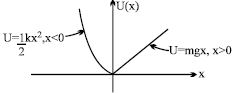
- 8A particle of mass $m$ moves in the potential energy $U$ shown above. The period of the motion when the particle has total energy $E$ isView Solution
- 9One-forth length of a spring of force constant $K$ is cut away. The force constant of the remaining spring will beView Solution
- 10Displacement between maximum potential energy position and maximum kinetic energy position for a particle executing $S.H.M.$ isView Solution