A particle of mass m is under the influence of a force $F$ which varies with the displacement $x$ according to the relation $F = - kx + {F_0}$ in which $k$ and ${F_0}$ are constants. The particle when disturbed will oscillate
Medium
Download our app for free and get started
(c) Restoring force is zero at mean position
$F = - Kx + {F_0}$$\Rightarrow$ $0 = - Kx + {F_0}$$\Rightarrow$ $x = \frac{{{F_0}}}{K}$
i.e. the particle will oscillate about $x = \frac{{{F_0}}}{K}$

Download our appand get started for free
Experience the future of education. Simply download our apps or reach out to us for more information. Let's shape the future of learning together!No signup needed.*
Similar Questions
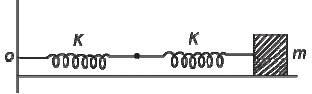
- 1The frequency of oscillations of a mass $m$ connected horizontally by a spring of spring constant $k$ is $4 Hz$. When the spring is replaced by two identical spring as shown in figure. Then the effective frequency is,View Solution
- 2A spring mass system preforms $S.H.M.$ If the mass is doubled keeping amplitude same, then the total energy of $S.H.M.$ will become :View Solution
- 3View SolutionTime period of pendulum, on a satellite orbiting the earth, is
- 4If the mass of the bob in a simple pendulum is increased to thrice its original mass and its length is made half its original length, then the new time period of oscillation is $\frac{x}{2}$ times its original time period. Then the value of $x$ is:View Solution
- 5The displacement y of a particle executing periodic motion is given by $y = 4{\cos ^2}(t/2)\sin (1000t)$. This expression may be considered to be a result of the superposition of ........... independent harmonic motionsView Solution
- 6A uniform thin ring of radius $R$ and mass $m$ suspended in a vertical plane from a point in its circumference. Its time period of oscillation is ........View Solution
- 7A particle free to move along the $x-$axis has potential energy given by $U(x) = k[1 - \exp {( - x)^2}]$ for $ - \infty \le x \le + \infty $, where k is a positive constant of appropriate dimensions. ThenView Solution
- 8View SolutionA system exhibiting S.H.M. must possess
- 9View SolutionTwo mutually perpendicular simple harmonic vibrations have same amplitude, frequency and phase. When they superimpose, the resultant form of vibration will be
- 10In an angular $SHM$ angular amplitude of oscillation is $\pi $ $rad$ and time period is $0.4\,sec$ then calculate its angular velocity at angular displacement $ \pi/2 \,rad$. ..... $rad/sec$View Solution