A particle of mass m is under the influence of a force $F$ which varies with the displacement $x$ according to the relation $F = - kx + {F_0}$ in which $k$ and ${F_0}$ are constants. The particle when disturbed will oscillate
Medium


Download our appand get started for free
Experience the future of education. Simply download our apps or reach out to us for more information. Let's shape the future of learning together!No signup needed.*
Similar Questions
- 1A light pointer fixed to one prong of a tuning fork touches a vertical plate. The fork is set vibrating and the plate is allowed to fall freely. If eight oscillations are counted when the plate falls through $10 cm$, the frequency of the tuning fork is .... $Hz$View Solution
- 2The equation of $S.H.M.$ is $y = a\sin (2\pi nt + \alpha )$, then its phase at time $t$ isView Solution
- 3A simple harmonic oscillator has an amplitude $A$ and time period $6 \pi$ second. Assuming the oscillation starts from its mean position, the time required by it to travel from $x=A$ to $x=\frac{\sqrt{3}}{2} A$ will be $\frac{\pi}{x}$ s, where $x=$__________.View Solution
- 4A block of rectangular size of mass $m$ and area of cross-section $A$, floats in a liquid of density $\rho$. If we give a small vertical displacement from equilibrium, it undergoes $S H M$ with time period $T$, thenView Solution
- 5A particle moving along the $X-$axis executes simple harmonic motion, then the force acting on it is given byView Solution
Where $A$ and $K$ are positive constants
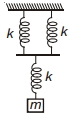
- 6A block of mass $m$ hangs from three springs having same spring constant $k$. If the mass is slightly displaced downwards, the time period of oscillation will beView Solution
- 7A particle is performing simple harmonic motion with amplitude A and angular velocity ${\omega }$. The ratio of maximum velocity to maximum acceleration isView Solution
- 8A point mass is subjected to two simultaneous sinusoidal displacements in x-direction, $x_1(t)=A \sin \omega t $ and $ x_2(t)=A \sin \left(\omega t+\frac{2 \pi}{3}\right)$. Adding a third sinusoidal displacement $x_3(t)=B \sin (\omega t+\phi)$ brings the mass to a complete rest. The values of $B$ and $\phi$ areView Solution
- 9View SolutionThe total energy of a particle executing simple harmonic motion is
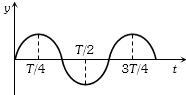
- 10View SolutionThe graph shows the variation of displacement of a particle executing S.H.M. with time. We infer from this graph that