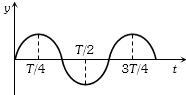
The graph shows the variation of displacement of a particle executing S.H.M. with time. We infer from this graph that
Medium
Download our app for free and get started
(d)At time $\frac{T}{2};\;v = 0$ $\therefore $Total energy = Potential energy.

Download our appand get started for free
Experience the future of education. Simply download our apps or reach out to us for more information. Let's shape the future of learning together!No signup needed.*
Similar Questions
- 1The displacement of a particle from its mean position (in metre) is given byView Solution
$y = 0.2\sin \left( {10\pi t + 1.5\pi } \right)\cos \left( {10\pi t + 1.5\pi } \right)$
The motion of particle is
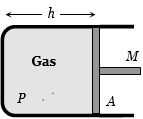
- 2A cylindrical piston of mass $M$ slides smoothly inside a long cylinder closed at one end, enclosing a certain mass of gas. The cylinder is kept with its axis horizontal. If the piston is disturbed from its equilibrium position, it oscillates simple harmonically. The period of oscillation will beView Solution
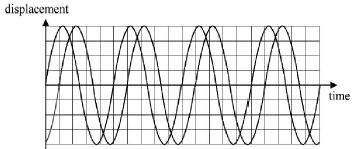
- 3View SolutionThe diagram shows two oscillations. What is the phase difference between the oscillations?
- 4View SolutionA flat horizontal board moves up and down in $SHM$ of amplitude $\alpha$. Then the shortest permissible time period of the vibration such that an object placed on the board may not lose contact with the board is
- 5Equations ${y_1} = A\sin \omega t$ and ${y_2} = \frac{A}{2}\sin \omega t + \frac{A}{2}\cos \omega t$ represent $S.H.M.$ The ratio of the amplitudes of the two motions isView Solution
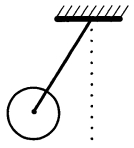
- 6A metal rod of length ' $L$ ' and mass ' $m$ ' is pivoted at one end. A thin disk of mass ' $M$ ' and radius $'R'$ $( < L)$ is attached at its center to the free end of the rod. Consider two ways the disc is attached: (case $A$) The disc is not free to rotate about its center and (case $B$) the disc is free to rotate about its center. The rod-disc system performs $SHM$ in vertical plane after being released from the same displaced position. Which of the following statement$(s)$ is (are) true? $Image$View Solution
$(A)$ Restoring torque in case $A =$ Restoring torque in case $B$
$(B)$ Restoring torque in case $A < $ Restoring torque in case $B$
$(C)$ Angular frequency for case $A > $ Angular frequency for case $B$.
$(D)$ Angular frequency for case $A < $ Angular frequency for case $B$.
- 7A particle executes $S.H.M$ between $x =\, -A$ to $x =\, +A$ . The time taken for it in going from $0$ to $A/2$ is $T_1$ and from $A/2$ to $A$ is $T_2$. ThenView Solution
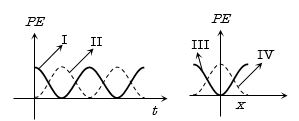
- 8For a particle executing $S.H.M.$ the displacement $x$ is given by $x = A\cos \omega t$. Identify the graph which represents the variation of potential energy $(P.E.)$ as a function of time $t$ and displacement $x$View Solution
- 9A rectangular block of mass $m$ and area of cross-section $A$ floats in a liquid of density $\rho $. If it is given a small vertical displacement from equilibrium it undergoes with a time period $T,$ thenView Solution
- 10A pendulum with time period of $1\, s$ is losing energy due to damping. At certain time its energy is $45\, J$. If after completing $15\,oscillations$ , its energy has become $15\, J$, its damping constant (in $s^{-1}$ ) isView Solution