A particle of unit mass is moving along the $x$-axis under the influence of a force and its total energy is conserved. Four possible forms of the potential energy of the particle are given in column $I$ (a and $U _0$ are constants). Match the potential energies in column $I$ to the corresponding statement$(s)$ in column $II.$
| column $I$ | column $II$ |
| $(A)$ $U _1( x )=\frac{ U _0}{2}\left[1-\left(\frac{ x }{ a }\right)^2\right]^2$ | $(P)$ The force acting on the particle is zero at $x = a$. |
| $(B)$ $U _2( x )=\frac{ U _0}{2}\left(\frac{ x }{ a }\right)^2$ | $(Q)$ The force acting on the particle is zero at $x=0$. |
| $(C)$ $U _3( x )=\frac{ U _0}{2}\left(\frac{ x }{ a }\right)^2 \exp \left[-\left(\frac{ x }{ a }\right)^2\right]$ | $(R)$ The force acting on the particle is zero at $x =- a$. |
| $(D)$ $U _4( x )=\frac{ U _0}{2}\left[\frac{ x }{ a }-\frac{1}{3}\left(\frac{ x }{ a }\right)^3\right]$ | $(S)$ The particle experiences an attractive force towards $x =0$ in the region $| x |< a$. |
| $(T)$ The particle with total energy $\frac{ U _0}{4}$ can oscillate about the point $x=-a$. |
IIT 2015, Diffcult
Download our app for free and get started
Second Method
$(A)$ $\overrightarrow{ F }=-\frac{ dU }{ dx } \hat{ i }=-\frac{ U _0}{2} 2\left(1-\left(\frac{ x }{ a }\right)^2\right) \times\left[-2\left(\frac{ x }{ a }\right) \times \frac{1}{ a }\right] \hat{ i }=2 U _0\left[1-\left(\frac{ x }{ a }\right)^2\right]\left[\frac{ x }{ a ^2}\right] \hat{ i }$
If $x=0 \Rightarrow \vec{F}=\frac{ U _0}{2}[2(1) \times 0]=\overrightarrow{0}, U =\frac{ U _0}{2}$
If $x=a \Rightarrow \vec{F}=\overrightarrow{0}, \& U=0$
If $x=-a \Rightarrow \vec{F}=\overrightarrow{0}, \& U=0$
$(B)$ $\overrightarrow{ F }=-\frac{ U _0}{2} \times 2\left(\frac{ x }{ a }\right) \times \frac{1}{ a } \hat{ i }=-\frac{ U _0 x }{ a ^2} \hat{ i }$
If $x=0 \Rightarrow \overrightarrow{ F }=0$ and $U =0$
If $x = a \Rightarrow \overrightarrow{ F }=-\frac{ U _0}{ a } \hat{ i }$ and $U =\frac{ U _0}{2}$
If $x=-a \Rightarrow \vec{F}=+\frac{U_0}{a} \hat{i}$ and $U=\frac{U_0}{2}$
For $(C)$ and $(D)$, similarly we can solve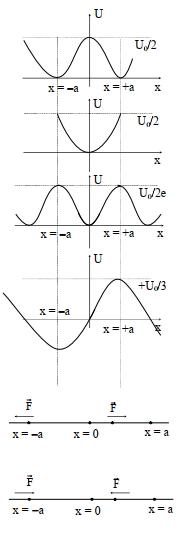

Download our appand get started for free
Experience the future of education. Simply download our apps or reach out to us for more information. Let's shape the future of learning together!No signup needed.*
Similar Questions
- 1View SolutionThe time period of a simple pendulum when it is made to oscillate on the surface of moon
- 2A simple harmonic oscillator of angular frequency $2\,rad\,s^{-1}$ is acted upon by an external force $F = sin\,t\,N .$ If the oscillator is at rest in its equilibrium position at $t = 0,$ its position at later times is proportional toView Solution
- 3The scale of a spring balance reading from $0$ to $10 \,kg$ is $0.25\, m$ long. A body suspended from the balance oscillates vertically with a period of $\pi /10$ second. The mass suspended is ..... $kg$ (neglect the mass of the spring)View Solution
- 4Two simple pendulums of length $0.5\, m$ and $2.0\, m$ respectively are given small linear displacement in one direction at the same time. They will again be in the phase when the pendulum of shorter length has completed .... oscillations.View Solution
- 5View SolutionThe velocity of a particle performing simple harmonic motion, when it passes through its mean position is
- 6Two pendulums have time periods $T$ and $5T/4.$ They start $SHM$ at the same time from the mean position. After how many oscillations of the smaller pendulum they will be again in the same phase :View Solution
- 7View SolutionA simple pendulum is set into vibrations. The bob of the pendulum comes to rest after some time due to
- 8For a simple harmonic motion in a mass spring system shown, the surface is frictionless. When the mass of the block is $1\,kg$, the angular frequency is $\omega_1$. When the mass block is $2\,kg$ the angular frequency is $\omega_2$. The ratio $\omega_2 / \omega_1$ isView Solution
- 9Two simple pendulums of length $1\, m$ and $4\, m$ respectively are both given small displacement in the same direction at the same instant. They will be again in phase after the shorter pendulum has completed number of oscillations equal toView Solution
- 10A block of mass $2\,kg$ is attached with two identical springs of spring constant $20\,N / m$ each. The block is placed on a frictionless surface and the ends of the springs are attached to rigid supports (see figure). When the mass is displaced from its equilibrium position, it executes a simple harmonic motion. The time period of oscillation is $\frac{\pi}{\sqrt{x}}$ in SI unit. The value of $x$ is $..........$View Solution