The time period of a simple pendulum when it is made to oscillate on the surface of moon
Easy
Download our app for free and get started
(a) At the surface of moon, $g$ decreases hence time period increases $\left( {{\rm{as}}\,T \propto \frac{1}{{\sqrt g }}} \right)$

Download our appand get started for free
Experience the future of education. Simply download our apps or reach out to us for more information. Let's shape the future of learning together!No signup needed.*
Similar Questions
- 1Assume that the earth is a solid sphere of uniform density and a tunnel is dug along its diameter throughout the earth. It is found that when a particle is released in this tunnel, it executes a simple harmonic motion. The mass of the particle is $100 g$. The time period of the motion of the particle will be (approximately) (take $g =10\,ms ^{-2}$, radius of earth $=6400\,km$ )View Solution
- 2A simple pendulum oscillating in air has period $T.$ The bob of the pendulum is completely immersed in a non-viscous liquid. The density of the liquid is $\frac {1}{16}$ of the material of the bob. If the bob is inside liquid all the time, its period of oscillation in this liquid isView Solution
- 3$2$ particles $p$ and $q$ describe $SHM$ of same amplitude $a$ and same frequency $f$ along straight line, the maximum distance between the two particle $a\sqrt 2 $ . The initial phase difference between particle isView Solution
- 4A particle executing simple harmonic motion with amplitude of $0.1 \,m$. At a certain instant when its displacement is $0.02 \,m$, its acceleration is $0.5 \,m/s^2$. The maximum velocity of the particle is (in $m/s$)View Solution
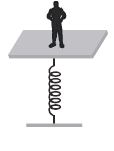
- 5A man weighing $60\ kg$ stands on the horizontal platform of a spring balance. The platform starts executing simple harmonic motion of amplitude $0.1\ m$ and frequency $\frac{2}{\pi } Hz$. Which of the following staements is correctView Solution
- 6The time period of a seconds pendulum is $2\, sec$. The spherical bob which is empty from inside has a mass $50\; gram$, this now is replaced by another solid of same radius but have different mass of $100\; gram$. The new time period will be ..... $\sec$View Solution
- 7Two simple harmonic motions, as shown, are at right angles. They are combined to form Lissajous figuresView Solution
$x\left( t \right) = A\,\sin \,\left( {at + \delta } \right)$
$y\left( t \right) = B\,\sin \,\left( {bt} \right)$
Identify the correct match below
- 8A block of mass $200\, g$ executing $SHM$ under the influence of a spring of spring constant $K=90\, N\,m^{-1}$ and a damping constant $b=40\, g\,s^{-1}$. The time elapsed for its amplitude to drop to half of its initial value is ...... $s$ (Given $ln\,\frac{1}{2} = -0.693$)View Solution
- 9The equation of motion of a particle is $\frac{{{d^2}y}}{{d{t^2}}} + Ky = 0$, where $K$ is positive constant. The time period of the motion is given byView Solution
- 10A point object is kept in front of a plane mirror. The plane mirror is doing $SHM$ of amplitude $2\,cm$. The plane mirror moves along the $x-$ axis and $x-$ axis is normal to the mirror. The amplitude of the mirror is such that the object is always infront of the mirror. The amplitude of $SHM$ of the image is .... $cm$View Solution