Question
A particle performing simple harmonic motion makes 1200 oscillations per minute and its velocity while passing through the mean position is $3.14 m / s$ lives. Also obtain the displacement equation of the particle if the displacement at moment $t=0$.
Answer

We know that the velocity of the particle is maximum in the mean position. If the particle's amplitude is $A$ and angular velocity is $\omega$ then maximum velocity.
$\begin{aligned}v_{\max } & =\omega A \\\text { Amplitude } A & =\frac{V_{\max }}{\omega}=\frac{V_{\max }}{2 \pi n}\end{aligned}$
$\because \omega=2 \pi n$, Here frequency is $n$,
As per question
$\begin{aligned}v_{\max } & =3.1 m / s \\n & =1200 \text { per minute }=\frac{1200}{60} \text { per second } \\n & =20 \text { per second } \\\text { Amplitude } A & =\frac{3.1}{2 \times 3.14 \times 20}=\frac{1}{40}=0.025 m\end{aligned}$
Displacement of the particle at $t=0$ that is the particle is in its equilibrium state, then the equation of simple harmonic motion is,
$y=A \sin \omega t=A \sin 2 \pi n t$
Keeping the value of A and $n$
$\begin{array}{l}y=0.025 \sin 2 \pi \times 20 t \\y=0.025 \sin 40 \pi t\end{array}$

Need a full question paper?

Generate a complete, print-ready paper with questions like this in minutes — across 16+ boards, with answer keys.

Start Generating Free

Similar questions

Given below are some functions of x and t to represent the displacement of an elastic wave.
$\text{y}=5\cos(4\times)\sin(20\text{t})$
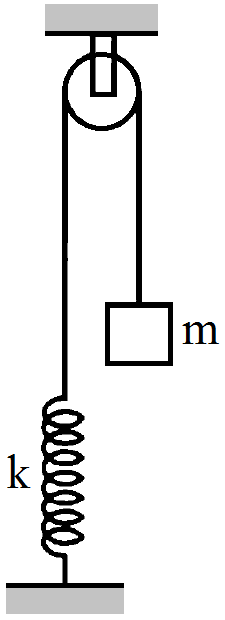
Consider the situation shown in figure. Initially the spring is unstretched when the system is released from rest. Assuming no friction in the pulley, find the maximum elongation of the spring.
The refractive index of a material changes by 0.014 as the colour of the light changes from red to violet. A rectangular slab of height 2.00cm made of this material is placed on a newspaper. When viewed normally in yellow light, the letters appear 1.32cm below the top surface of the slab. Calculate the dispersive power of the material.
Give the magnitude and direction of the net force acting on a stone of mass 0.1 kg , (Neglect air resistance throughout.) Lying on the floor of a train which is accelerating with $1 \mathrm{~ms}^{-2}$, the stone being at rest relative to the train.
Write Maxwell's law of equipartition of energy.
Pressure of a gas in a closed cylinder is expressed in the following way : $\text{P}=\text{P}_\text{a}+\text{h}\rho\text{g}$
Identify the expressions for:
  1. Absolute pressure of the gas.
  2. Gauge pressure of the gas.
A filter transmits only the radiation of wavelength greater than 440nm. Radiation from a hydrogen-discharge tube goes through such a filter and is incident on a metal of work function 2.0eV. Find the stopping potential which can stop the photoelectrons.
The excess pressure inside a soap bubble is thrice the excess pressure inside a moving soap bubble. What is the ratio between the volume of the first and second bubble?
The length and breadth of a rectangle are $(5.7\pm0.1)\text{cm}$ and $(3.4\pm0.2)\text{cm}$ Calculate area of the rectangle with error limits.
Show that Newton's second law is the Real Law of Motion.