Question
The excess pressure inside a soap bubble is thrice the excess pressure inside a moving soap bubble. What is the ratio between the volume of the first and second bubble?

Answer

Let $r_1$ and $r_2$ be the radii of soap bubbles, excess pressure in them are $\frac{4\sigma}{\text{r}_1}$ and $\frac{4\sigma}{\text{r}_2},$ where $\sigma$ is the surface tension. Given: $\text{P}_1=\text{3P}_2$$\frac{4\sigma}{\text{r}_1}=3\frac{4\sigma}{\text{r}_2}$
$\therefore\text{r}_2=3\text{r}_1$
Volume fo first to second bubble,$=\frac{\text{r}_1^3}{\text{r}^3_2}=\frac{1}{3^3}=\frac{1}{27}$

Need a full question paper?

Generate a complete, print-ready paper with questions like this in minutes — across 16+ boards, with answer keys.
Start Generating Free

Similar questions

Of the three stars in the sky, one is visible white the other red and the third blue. Which of these will have minimum temperature and which will have maximum temperature?
Percentage error in the measurement of height and radius of cylinder are x and y respectively. Find percentage error in the measurement of volume. Which of the two measurements height or radius need more attention?
$1~\text {cm}^3$ sample of oxygen has been given at normal temperature and pressure which sample has more number of molecules?
Given below are some functions of x and t to represent the displacement of an elastic wave.
$\text{y}=5\cos(4\times)\sin(20\text{t})$
A water pipe entering a hose has a dimeter of 2cm and the speed of water is $0.1ms^{-1}$. Eventually, the pipe tapers to a diameter of 1cm. Calculate the speed of water in the tapered portion.
A 10kg mass is to be divided into two parts, such that the force of attraction between them is maximum. What is the mass of each portion?
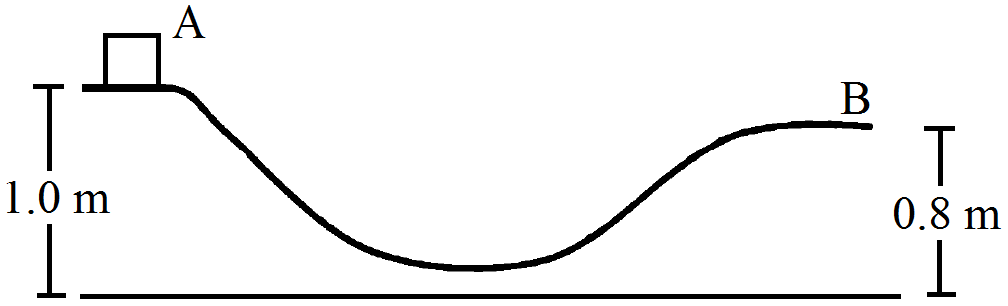
A block of mass 1kg is placed at the point A of a rough track shown in figure. If slightly pushed towards right, it stops at the point B of the track. Calculate the work done by the frictional force on the block during its transit from A to B.
If each square metre of sun's surface, radiates energy at the rate of $6.3 \times 10^7 \mathrm{~J} / \mathrm{m}^2 / \mathrm{s}$ and the Stefan's constant is $5.669 \times 10^{-8} \mathrm{~W} / \mathrm{m}^2 / \mathrm{k}^4$. Calculate the temperature of the sun's energy assuming Stefan's Law applies to the sun's rediation.
Can the centre of mass of a body be at a point outside the body?
Does a body at 20°C radiate in a room, where the room temperature is 30°C? If yes, why does its temperature not fall further?