MCQ
A particle performs simple harmonic motion with amplitude A along a straight line. The potential energy of the particle will be maximum when its displacement is :
  • $\pm A$
  • B
    Zero
  • C
    $\pm \frac{A}{2}$
  • D
    $\pm \frac{ A }{\sqrt{2}}$

Answer

Correct option: A.
$\pm A$
(A)

Need a full question paper?

Generate a complete, print-ready paper with questions like this in minutes — across 16+ boards, with answer keys.

Start Generating Free

Similar questions

If the radius of a star is $R$ and it acts as a black body, what would be the temperature of the star, in which the rate of energy production is $Q$?

($\sigma$ stands for Stefan's constant)
A guitar string of length $90\,cm$ vibrates with a fundamental frequency of $120\,Hz.$ The length of the string producing a fundamental frequency of $180\,Hz$ will be $...........cm$.
A particle is thrown with a speed of $12\, m/s$ at an angle $60^o$ with the horizontal. The time interval between the moments when its speed is $10\, m/s$ is $(g = 10\, m/s^2)$.........$s$
Three forces start acting simultaneously on a particle moving with velocity $\vec{\text{v}.}$ These forces are represented in magnitude and direction by three sides of a triangle taken in the same order. The particle will now move with a velocity.
An ideal gas heat engine operates in a Carnot cycle between $227^\circ C$ and $127^\circ C.$ It absorbs $6\ \text{k cal}$ of heat at higher temperature. The amount of heat in $\text{k cal}$ rejected to $\sin k$ is
A force of ${10^3}$ newton stretches the length of a hanging wire by $1$ millimetre. The force required to stretch a wire of same material and length but having four times the diameter by $1$ millimetre is
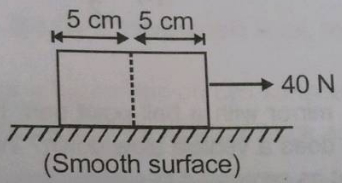
A block of mass $m$ as shown in figure is pulled by a force $40 \,N$. The tension at the middle of the block is ........... $N$
A man of mass $80\ kg$ is standing inside a lift moving upward with a uniform velocity of $4\ m/s$ then the apparent weight of the person will be
Two stones are thrown up vertically and simultaneously but with different speeds. Which graph correctly represents the time variation of their relative positions $\Delta x$.Assume that stones do not bounce after hitting ground.
The bulk moduli of ethanol, mercury and water are given as $0.9, 25$ and $2 .2$ respectively in units of $10^9\, Nm^{-2}$ . For a given value of pressure, the fractional compression in volume is $\frac{{\Delta V}}{V}$. Which of the following statements about $\frac{{\Delta V}}{V}$ for these three liquids is correct ?