MCQ
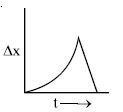
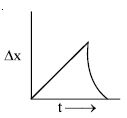
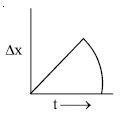
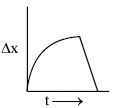
Two stones are thrown up vertically and simultaneously but with different speeds. Which graph correctly represents the time variation of their relative positions $\Delta x$.Assume that stones do not bounce after hitting ground.
  • A

  • B


  • D

Answer

Correct option: C.

c

Need a full question paper?

Generate a complete, print-ready paper with questions like this in minutes — across 16+ boards, with answer keys.
Start Generating Free

Similar questions

A body of mass $‘m’$ is dropped from a height of $‘h’$. Simultaneously another body of mass $2m$ is thrown up vertically with such a velocity $v$ that they collide at the height $h/2$. If the collision is perfectly inelastic, the velocity at the time of collision with the ground will be :
A ball is projected with kinetic energy $E$, at an angle of $60^{\circ}$ to the horizontal. The kinetic energy of this ball at the highest point of its flight will become.
The figure shows a velocity-time graph of a particle moving along a straight line  The correct acceleration-time graph of the particle is shown as
A string of negligible thickness is wrapped several times around a cylinder kept on a rough horizontal surface. A man standing at a distance $1$ from the cylinder holds one end of the string and pulls the cylinder towards him. There is no slipping anywhere. The length of the string passed through the hand of the man while the cylinder reaches his hands is:
A composite rod made up of two rods $AB$ and $BC$ are joined at $B$ . The rods are of equal length at room temperature and have equal masses. The coefficient of linear expansion a of $AB$ is more than that of $BC$. The composite rod is suspended horizontal by means of a thread at $B$. When the rod is heated
If liquid level falls in a capillary then radius of capillary will
Specific heats of monoatomic and diatomic gas is same than which relation is valid
A body lying initially at point $(3,7)$ starts moving with a constant acceleration of $4 \hat{i}$. Its position after $3 \,s$ is given by the co-ordinates ..........
During the thermodynamic process shown in figure for an ideal gas
A particle starts from rest at a distance $R$ from the centre and along the axis of a fixed ring of radius $R \&$ mass $M.$ Its velocity at the centre of the ring is :