MCQ
A particle projected from ground moves at angle $45^{\circ}$ with horizontal one second after projection and speed is minimum two seconds after the projection. The angle of projection of particle is [Neglect the effect of air resistance]
  • A
    $\tan ^{-1}(3)$
  • $\tan ^{-1}(2)$
  • C
    $\tan ^{-1}(\sqrt{2})$
  • D
    $\tan ^{-1}(4)$

Answer

Correct option: B.
$\tan ^{-1}(2)$
b
(b)

$\theta=45^{\circ}, t=1 \,s$

$\tan \phi=\frac{V_y}{U_y}=\frac{u \sin \theta-g t}{u \cos \theta}$

$\tan 45^{\circ}=\frac{u \sin \theta-g \times 1}{u \cos \theta} \Rightarrow u \cos \theta=u \sin \theta-g$

also, $V_y=0$, after $1^{\text {st }}$ (as speed is minimum)

$u \sin \theta-g \times 2=0$

$\Rightarrow u \sin \theta=2 g \ldots (i)$

so, $u \cos \theta=2 g-g$

$u \cos \theta=g \ldots (ii)$

so, $\frac{(i)}{(ii)}=\frac{u \sin \theta}{u \cos \theta}=\frac{2 g}{g}$

$\Rightarrow \tan \theta=2$

$\theta=\tan ^{-1}(2)$

Need a full question paper?

Generate a complete, print-ready paper with questions like this in minutes — across 16+ boards, with answer keys.

Start Generating Free

Similar questions

Zero error of an instrument introduces
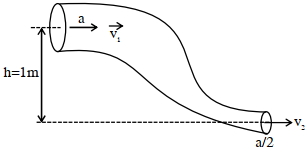
An ideal fluid of density $800 \; kgm ^{-3}$, flows smoothly through a bent pipe (as shown in figure) that tapers in cross-sectional area from $a$ to $\frac{ a }{2}$. The pressure difference between the wide and narrow sections of pipe is $4100 \; Pa$. At wider section, the velocity of fluid is $\frac{\sqrt{x}}{6} \; ms ^{-1}$ for $x = \dots$ $\left(\right.$ Given $g =10 \; m ^{-2}$ )
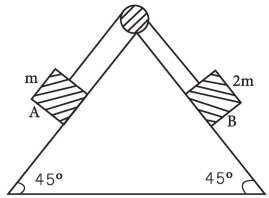
Consider the diagram shown below in which two masses of $m$ and $2 m$ are placed on a fixed triangular wedge. The coefficient of friction between block $A$ and the wedge is $2 / 3$, while that for block $B$ and the wedge is $1 / 3$
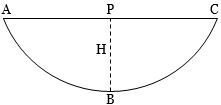
A simple pendulum with a bob of mass $‘m’$ oscillates from $A$ to $ C$ and back to $A$ such that $PB$ is $H.$ If the acceleration due to gravity is $‘g’$, then the velocity of the bob as it passes through $B$ is
From Newton's second law of motion, it can be inferred that
Thief's car is moving with a speed of $10\,m/s$. A police van chasing this car with a speed of $5\,m/s$ fires a bullet at the thief's car with muzzle velocity $72\,km/h$. Find the speed with which the bullet with hit the car.............$m/s$
If a small orifice is made at a height of $0.25\, m$ from the ground, the horizontal range of water stream will be, (in $cm$)
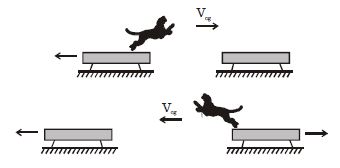
A strange cat with a mass $m_c$ is sitting at rest on the left plank of a pair of identical planks. Each plank has mass $m_s$ and they rest on frictionless ice. Suddenly, the cat leaps to the right plank, traveling with a horizontal speed $v_{cg}$ measured with respect to the ground. The instant the cat reaches the right plank, it turns around and leaps back to the left plank. The horizontal component of the cat’s speed is again $v_{cg}$ measured with respect to the ground. The final speed of right plank in terms of the masses of the cat and planks and the cat’s leaping speed is (The cat remains on the left plank after its return).
Vibrating tuning fork of frequency $n$ is placed near the open end of a long cylindrical tube. The tube has a side opening and is fitted with a movable reflecting piston. As the piston is moved through $8.75 cm$, the intensity of sound changes from a maximum to minimum. If the speed of sound is $350 \,m/s. $ Then $n$ is .... $Hz$
The temperature of an open room of volume $30\ m^3$ increases from $17^o C$ to $27vC$ due to sunshine. The atmospheric pressure in the room remains $1 \times 10^5\ Pa$. Ifni and nr are the number of molecules in the room before and after heating, then $n_f-n_i$ will be :