MCQ
Zero error of an instrument introduces
  • Systematic errors
  • B
    Random errors
  • C
    Both
  • D
    None

Answer

Correct option: A.
Systematic errors
a
Random errors in experimental measurements are caused by unknown and unpredictable changes in the experiment.

Systematic errors in experimental observations usually come from the measuring instruments.

Thus zero error is recognized as the systematic error (factual).

Need a full question paper?

Generate a complete, print-ready paper with questions like this in minutes — across 16+ boards, with answer keys.
Start Generating Free

Similar questions

An ideal gas is enclosed in a cylinder at pressure of $2\,atm$ and temperature, $300\,K.$ The mean time between two successive collisions is $6 \times 10^{-8}\, s.$ If the pressure is doubled and temperature is increased to $500\,K,$ the mean time between two successive collisions will be close to
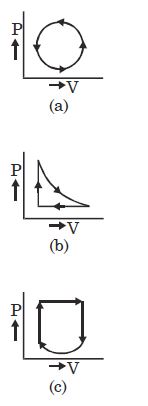
What is the nature of change in internal energy in the following three thermodynamical processes shown in figure
Oxygen and hydrogen are at the same tempeature T. The kinetic energy of the oxygen molecule is equal to the kinetic energy of the hydrogen molecule.
Given below are two statements: one is labelled as Assertion $A$ and the other is labelled as Reason $R$.

Assertion $A$ : Body $'P'$ having mass $M$ moving with speed $'u'$ has head-on collision elastically with another body $'Q'$ having mass $'m'$ initially at rest. If $m< < M,$ body $'Q'$ will have a maximum speed equal to $'2u'$ after collision.

Reason $R$ : During elastic collision, the momentum and kinetic energy are both conserved.

In the light of the above statements, choose the most appropriate answer from the options given below:

An object of mass $1 kg$ is taken to a height from the surface of earth which is equal to three times the radius of earth. The gain in potential energy of the object will be $....MJ$[If, $g =10\,ms ^{-2}$ and radius of earth $=6400\,km$ ]
A particle of unit mass is moving along the $x$-axis under the influence of a force and its total energy is conserved. Four possible forms of the potential energy of the particle are given in column $I$ (a and $U _0$ are constants). Match the potential energies in column $I$ to the corresponding statement$(s)$ in column $II.$

column $I$ column $II$
$(A)$ $U _1( x )=\frac{ U _0}{2}\left[1-\left(\frac{ x }{ a }\right)^2\right]^2$ $(P)$ The force acting on the particle is zero at $x = a$.
$(B)$ $U _2( x )=\frac{ U _0}{2}\left(\frac{ x }{ a }\right)^2$ $(Q)$ The force acting on the particle is zero at $x=0$.
$(C)$ $U _3( x )=\frac{ U _0}{2}\left(\frac{ x }{ a }\right)^2 \exp \left[-\left(\frac{ x }{ a }\right)^2\right]$ $(R)$ The force acting on the particle is zero at $x =- a$.
$(D)$ $U _4( x )=\frac{ U _0}{2}\left[\frac{ x }{ a }-\frac{1}{3}\left(\frac{ x }{ a }\right)^3\right]$ $(S)$ The particle experiences an attractive force towards $x =0$ in the region $| x |< a$.
  $(T)$ The particle with total energy $\frac{ U _0}{4}$ can oscillate about the point $x=-a$.


For a particle in circular motion the centripetal acceleration is
A student says that he had applied a force $\text{F}=-\text{k}\sqrt{\text{x}}$ on a particle and the particle moved in simple harmonic motion. He refuses to tell whether k is a constant or not. Assume that he was worked only with positive x and no other force acted on the particle.
  1. As x increases k increases.
  2. As x increases k decreases.
  3. As x increases k remains constant.
  4. The motion cannot be simple harmonic.
Select wrong statement about pressure ..........
A food packet is dropped from a helicopter rising up with a velocity of $4\,ms^{-1}.$ The velocity of the packet after three second will be.......$ms^{-1}$