MCQ
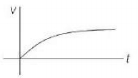
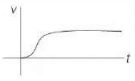
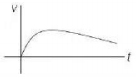
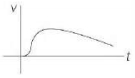
A particle released from rest is falling through a thick fluid under gravity. The fluid exerts a resistive force on the particle proportional to the square of its speed. Which one of the following graphs best depicts the variation of its speed $v$ with time $t$ ?

  • B

  • C

  • D

Answer

Correct option: A.

a
(a)

Velocity initially increases and this results in increase in resistive stokes force $(=6 \pi \eta r v)$.

After some time, resistive stokes force and force of buoyancy are equal to gravitational pull on the particle. After this instant velocity of particle becomes constant.

Hence, correct graph is $(a)$.

Need a full question paper?

Generate a complete, print-ready paper with questions like this in minutes — across 16+ boards, with answer keys.

Start Generating Free

Similar questions

A body of mass $3\, kg$ is under a constant force which causes a displacement $s$ in metres in it, given by the relation $s=$$\frac{1}{3}{t^2}$ , where $t$ is in seconds. Work done by the force in $2$ seconds is
Which of the following statements is false
Correct Bernoulli's equation is (symbols have their usual meaning) :
If $C$ and $R$ represent capacitance and resistance respectively, then the dimensions of $RC$ are
Three particles $A, B$ and $C $projected from the same point with the same initial speeds making angle $30^\circ , 45^\circ$ and $60^\circ ,$ respectively with the horizontally. Which of the following statements is correct?
If a body of mass $0.98\, kg$ is made to oscillate on a spring of force constant $4.84\, N/m$, the angular frequency of the body is ..... $ rad/s$
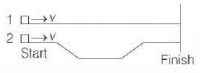
Two small blocks slide without losing contact with the surface along two frictionless tracks $1$ and $2$ , starting at the same time with same initial speed $v$. Track $1$ is perfectly horizontal, while track $2$ has a dip in the middle, as shown in the figure.Which block reaches the finish line first?[Hint: Use velocity-time graph to solve]
A particle is moving in a circular path. The acceleration and momentum of the particle at a certain moment are $\vec a = (4\hat i + 3\hat j)\ m/s^2$ and $\vec p = (8\hat i - 6\hat j)\ kg-m/s$ . The motion of the particle is
If an ideal gas has volume $V$ at $27°C$ and it is heated at a constant pressure so that its volume becomes $1.5V.$ Then the value of final temperature will be ....... $^oC$
The correct value of constant R in ideal gas equation in SI units is: