A pendulum bob has a speed of $3\, m/s$ at its lowest position. The pendulum is $0.5\, m$ long. The speed of the bob, when the length makes an angle of ${60^o}$ to the vertical, will be ..... $m/s$ (If $g = 10\,m/{s^2}$)
Medium
Download our app for free and get started
(d) Let bob velocity be $v$ at point $B$ where it makes an angle of $60^o$ with the vertical, then using conservation of mechanical energy
$K{E_A} + P{E_A} = K{E_B} + P{E_B}$
==> $\frac{1}{2}m \times {3^2} = \frac{1}{2}m{v^2} + mgl(1 - \cos \theta )$
$⇒ 9 = {v^2} + 2 \times 10 \times 0.5 \times \frac{1}{2} $
$⇒ v = 2\,m/s$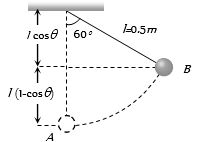

Download our appand get started for free
Experience the future of education. Simply download our apps or reach out to us for more information. Let's shape the future of learning together!No signup needed.*
Similar Questions
- 1A particle executes simple harmonic motion between $x =- A$ and $x =+ A$. If time taken by particle to go from $x=0$ to $\frac{A}{2}$ is $2 s$; then time taken by particle in going from $x =\frac{ A }{2}$ to $A$ is $.........\,s$View Solution
- 2View SolutionIn case of a forced vibration, the resonance wave becomes very sharp when the
- 3The displacement of a particle undergoing $SHM$ of time period $T$ is given by $x(t) = x_m\,cos\, (\omega t + \phi )$. The particle is at $x = -x_m$ at time $t = 0$. The particle is at $x = + x_m$ whenView Solution
- 4A $0.10\, kg$ block oscillates back and forth along a horizontal surface. Its displacement from the origin is given by: $x = (10\,cm)\cos [(10\,rad/s)\,t + \pi /2\,rad]$. What is the maximum acceleration experienced by the blockView Solution
- 5In simple harmonic motion, the total mechanical energy of given system is E. If mass of oscillating particle $P$ is doubled then the new energy of the system for same amplitude is:View Solution
- 6The equation of motion of a particle is $\frac{{{d^2}y}}{{d{t^2}}} + Ky = 0$, where $K$ is positive constant. The time period of the motion is given byView Solution
- 7Two particles are executing $SHM$ of the same amplitude $A$ and frequency $\omega $ along the $x-$ axis. Their mean position is separated by $X_0$ (where $X_0 > A$ ). If maximum separation between them is $X_0 + 2A$ , then the phase difference between their motion isView Solution
- 8The length of the second pendulum on the surface of earth is $1\, m$. The length of seconds pendulum on the surface of moon, where g is 1/6th value of $g$ on the surface of earth, isView Solution
- 9A particle of mass $m$ is moving along a trajectory given byView Solution
$x = x_0 + a\, cos\,\omega_1 t$
$y = y_0 + b\, sin\,\omega_2t$
The torque, acing on the particle about the origin, at $t = 0$ is - 10View SolutionResonance is an example of