The equation of motion of a particle is $\frac{{{d^2}y}}{{d{t^2}}} + Ky = 0$, where $K$ is positive constant. The time period of the motion is given by
AIEEE 2005, Easy
Download our app for free and get started
(c) On comparing with standard equation $\frac{{{d^2}y}}{{d{t^2}}} + {\omega ^2}y = 0$
we get ${\omega ^2} = K $
$\Rightarrow \omega = \frac{{2\pi }}{T} = \sqrt K$
$\Rightarrow T = \frac{{2\pi }}{{\sqrt K }}$.

Download our appand get started for free
Experience the future of education. Simply download our apps or reach out to us for more information. Let's shape the future of learning together!No signup needed.*
Similar Questions
- 1Two waves executing simple harmonic motion travelling in the same direction with same amplitude and frequency are superimposed. The resultant amplitude is equal to the $\sqrt{3}$ times of amplitude of individual motions. The phase difference between the two motions is $.....(degree)$View Solution
- 2View SolutionWhat is constant in S.H.M.
- 3Aheavy brass sphere is hung from a light spring and is set in vertical small oscillation with a period $T.$ The sphere is now immersed in a non-viscous liquid with a density $1/10\,th$ the density of the sphere. If the system is now set in vertical $S.H.M.,$ its period will beView Solution
- 4The function ${\sin ^2}(\omega t)$ representsView Solution
- 5View SolutionThe period of a simple pendulum is doubled, when
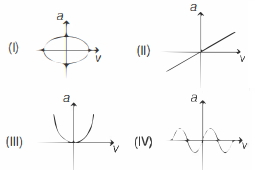
- 6If the speed $v$ of the bob in a simple pendulum is plotted against the tangential acceleration $a$, the correct graph will be represented byView Solution
- 7The angular frequency of a spring block system is $\omega _0.$ This system is suspended from the ceiling of an elevator moving downwards with a constant speed $v_0.$ The block is at rest relative to the elevator. Lift is suddenly stopped. Assuming the downwards as a positive direction, choose the wrong statement :View Solution
- 8The velocity of a particle executing SHM varies with displacement $( x )$ as $4 v ^2=50- x ^2$. The time period of oscillations is $\frac{x}{7} s$. The value of $x$ is $............$ $\left(\right.$ Take $\left.\pi=\frac{22}{7}\right)$View Solution
- 9A circular disc of mass $10 \;kg$ is suspended by a wire attached to its centre. The wire is twisted by rotating the disc and released. The period of torsional oscillations is found to be $1.5 \;s$. The radius of the disc is $15\; cm .$ Determine the torsional spring constant of the wire in $N\;m\;rad^{-1}$. (Torsional spring constant $\alpha$ is defined by the relation $J=-\alpha \theta,$ where $J$ is the restoring couple and $\theta$ the angle of twist).View Solution
- 10View SolutionWhich of the diagrams shown in figure represents variation of total mechanical energy of a pendulum oscillating in water as function of time ?