MCQ
A pendulum clock that keeps correct time on the earth is taken to the moon it will run (it is given that $g_{Moon} = g_{Earth}/6$ )
  • A
    At correct rate
  • B
    $6$ time faster
  • C
    $\sqrt 6 $ times faster
  • $\sqrt 6 $ times slowly

Answer

Correct option: D.
$\sqrt 6 $ times slowly
d
(d) $T = 2\pi \sqrt {\frac{l}{g}} $==>$\frac{{{T_e}}}{{{T_m}}} = \sqrt {\frac{{{g_m}}}{{{g_e}}}} = \sqrt {\frac{{{g_e}/6}}{{{g_e}}}} = \frac{1}{{\sqrt 6 }}$

$ \Rightarrow $ ${T_m} = \sqrt 6 {T_e}$ i.e. clock becomes slower.

Need a full question paper?

Generate a complete, print-ready paper with questions like this in minutes — across 16+ boards, with answer keys.

Start Generating Free

Similar questions

A string $1\,\,m$ long is drawn by a $300\,\,Hz$ vibrator attached to its end. The string vibrates in $3$ segments. The speed of transverse waves in the string is equal to .... $m/s$
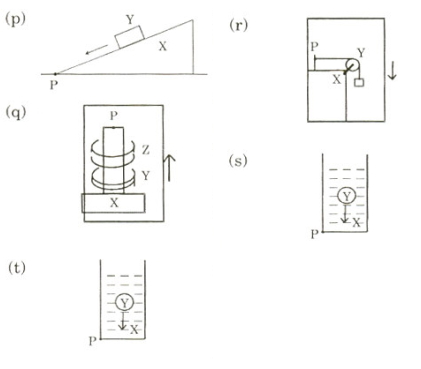
Column $II$ shows five systems in which two objects are labelled as $\mathrm{X}$ and $\mathrm{Y}$. Also in each case a point $\mathrm{P}$ is shown. Column $I$ gives some statements about $\mathrm{X}$ and/or $\mathrm{Y}$. Match these statements to the appropriate system$(s)$ from Column $II$.
Column $I$ Column $II$
$(A)$ The force exerted by $\mathrm{X}$ on $\mathrm{Y}$ has a magnitude $\mathrm{Mg}$. $Image$ Block $Y$ of mass $M$ left on a fixed inclined plane $\mathrm{X}$, slides on it with a constant velocity.
$(B)$ The gravitational potential energy of $\mathrm{X}$ is continuously increasing. $Image$ Two ring magnets $\mathrm{Y}$ and $\mathrm{Z}$, each of mass $M$, are kept in frictionless vertical plastic stand so that they repel each other. $Y$ rests on the base $X$ and $\mathrm{Z}$ hangs in air in equilibrium. $\mathrm{P}$ is the topmost point of the stand on the common axis of the two rings. The whole system is in a lift that is going up with a constant velocity.
$(C)$ Mechanical energy of the system $\mathrm{X}+\mathrm{Y}$ is continuously decreasing. $Image$ A pulley $Y$ of mass $m_0$ is fixed to a table through a clamp $X$. A block of mass $M$ hangs from a string that goes over the pulley and is fixed at point $\mathrm{P}$ of the table. The whole system is kept in a lift that is going down with a constant velocity.
$(D)$ The torque of the weight of $\mathrm{Y}$ about point $\mathrm{P}$ is zero. $Image$ A sphere $\mathrm{Y}$ of mass $M$ is put in a nonviscous liquid $\mathrm{X}$ kept in a container at rest. The sphere is released and it moves down in the liquid.
  $Image$ A sphere $\mathrm{Y}$ of mass $M$ is falling with its terminal velocity in a viscous liquid $\mathrm{X}$ kept in a container.

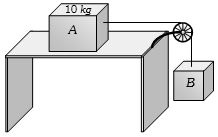
If mass of $A = 10\,\,kg$, coefficient of static friction $= 0.2$, coefficient of kinetic friction = $0.2$. Then mass of $B$ to start motion is
If the tension in the cable supporting an elevator is equal to the weight of the elevator, the elevator may be:
  1. Going up with increasing speed.
  2. Going down with increasing speed.
  3. Going up with uniform speed.
  4. Going down with uniform speed.
The average acceleration vector for a particle having a uniform circular motion is
A stationary object at $4°C$ and weighing $3.5\, kg$ falls from a height of $2000\, m$ on a snow mountain at  $0°C$. If the temperature of the object just before hitting the snow is $0°C$ and the object comes to rest immediately $(g = 10\,m/{s^2})$ and (latent heat of ice$ = 3.5 \times {10^5}\,joule/\sec $), then the object will melt
The motion of a particle of mass m is given by $\text{x}=0$ for $\text{t} < 0\ \text{s},$ $\text{x}(\text{t})=\text{A}\sin4\text{p}\ \text{t}$ for $0<\text{t}<(1/ 4)\ \text{s}(\text{A}>\text{o}),$ and $\text{x}=0$ for $\text{t}>(1/4)\ \text{s}.$ Which of the following statements is true?
  1. The force at t = (1/8) s on the particle is $–16\pi^2 \text{A m.}$
  2. The particle is acted upon by on impulse of magnitude $4π^2\text{A m}$ at $\text{t} = 0$ s and t = (1/4) s.
  3. The particle is not acted upon by any force.
  4. The particle is not acted upon by a constant force.
  5. There is no impulse acting on the particle.
If speed of sound in air in $330 \,m / s$ then, find the number of tones present in an open organ pipe of length $1\, m$ whose frequency if $\leq 1000$.
Three harmonic waves having equal frequency $\mathrm{v}$ and same intensity $\mathrm{I}_{0}$, have phase angles $0 , \frac{\pi}{4}$ and $-\frac{\pi}{4}$ respectively. When they are superimposed the intensity of the resultant wave is close to
The temperature of sink of Carnot engine is ${27^o}C$. Efficiency of engine is $25\%.$ Then temperature of source is ...... $^oC$