A pendulum suspended from the ceiling of a train has a period $T$, when the train is at rest. When the train is accelerating with a uniform acceleration a, the period of oscillation will
Easy
Download our app for free and get started
(b) Initially time period was $T = 2\pi \sqrt {\frac{l}{g}} $.
When train accelerates, the effective value of $g$ becomes $\sqrt {({g^2} + {a^2})} $ which is greater than $g$
Hence, new time period, becomes less than the initial time period.
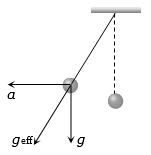
When train accelerates, the effective value of $g$ becomes $\sqrt {({g^2} + {a^2})} $ which is greater than $g$
Hence, new time period, becomes less than the initial time period.

Download our appand get started for free
Experience the future of education. Simply download our apps or reach out to us for more information. Let's shape the future of learning together!No signup needed.*
Similar Questions
- 1A particle is executing simple harmonic motion with a period of $T$ seconds and amplitude a metre. The shortest time it takes to reach a point $\frac{a}{{\sqrt 2 }}\,m$ from its mean position in seconds isView Solution
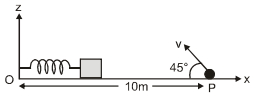
- 2A small block is connected to one end of a massless spring of un-stretched length $4.9 \ m$. The other end of the spring (see the figure) is fixed. The system lies on a horizontal frictionless surface. The block is stretched by $0.2$ $m$ and released from rest at $t =0$. It then executes simple harmonic motion with angular frequency $\omega=\frac{\pi}{3} \ rad / s$.View Solution
Simultaneously at $t=0$, a small pebble is projected with speed $v$ from point $P$ at an angle of $45^{\circ}$ as shown in the figure. Point $P$ is at a horizontal distance of $10 \ cm$ from $O$. If the pebble hits the block at $t=1 \ s$, the value of $v$ is (take $g =10 \ m / s ^2$ )
- 3A pendulum suspended from the ceiling of a train oscillates with a time period $2$ $second$ , when the train is accelerating at $10\,ms^{-2}$. What will be its time period when the train retards at $10\,ms^{-2}$ ? .... $s$View Solution
- 4When two displacements represented by $y_1 = asin\left( \omega t \right)$ and $y_2 = bcos\left(\omega t \right)$ are superimposed the motion isView Solution
- 5A particle moves with simple harmonic motion in a straight line. In first $\tau \,s$, after starting from rest, it travels a distance $a$, and in next $\tau \,s$, it travels $2a$ in same direction thenView Solution
- 6A particle in $SHM $ is described by the displacement equation $x(t) = A\cos (\omega t + \theta ).$ If the initial $(t = 0)$ position of the particle is $1 \,cm$ and its initial velocity is $\pi $cm/s, what is its amplitude? The angular frequency of the particle is $\pi {s^{ - 1}}$View Solution
- 7If $x, v$ and $a$ denote the displacement, the velocity and the acceleration of a particle executing simple harmonic motion of time period $T$, then, which of the following does not change with time?View Solution
- 8Amplitude of a mass-spring system, which is executing simple harmonic motion decreases with time. If mass $=500\, g$, Decay constant $=20 \,g / s$ then ...... $s$ time is required for the amplitude of the system to drop to half of its initial value ? $(\ln 2=0.693)$View Solution
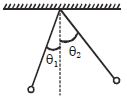
- 9Two masses, both equal to $100\, g$, are suspended at the ends of identical light strings of length $\lambda = 1.0\, m$, attached to the same point on the ceiling (see figure). At time $t = 0$, they are simultaneously released from rest, one at angle $\theta_1 = 1^o$, the other at angle $\theta_2 = 2^o$ from the vertical. The masses will collideView Solution
- 10If two similar springs each of spring constant $K _{1}$ are joined in series, the new spring constant and time period would be changed by a factorView Solution