A pendulum with time period of $1\, s$ is losing energy due to damping. At certain time its energy is $45\, J$. If after completing $15\,oscillations$ , its energy has become $15\, J$, its damping constant (in $s^{-1}$ ) is
JEE MAIN 2015, Medium


Download our appand get started for free
Experience the future of education. Simply download our apps or reach out to us for more information. Let's shape the future of learning together!No signup needed.*
Similar Questions
- 1View SolutionThe total energy of a particle, executing simple harmonic motion is
- 2If the period of oscillation of mass $m$ suspended from a spring is $2\, sec$, then the period of mass $4m$ will be .... $\sec$View Solution
- 3A uniform cylinder of length $L$ and mass $M$ having cross-sectional area $A$ is suspended, with its length vertical, from a fixed point by a massless spring, such that it is half submerged in a liquid of density $\sigma $ at equilibrium position. When the cylinder is given a downward push and released, it starts oscillating vertically with a small amplitude. The time period $T$ of the oscillations of the cylinder will beView Solution
- 4A body is executing simple harmonic motion with an angular frequency $2\,rad/s$. The velocity of the body at $20\, mm$ displacement, when the amplitude of motion is $60\, mm$, is ...... $mm/s$View Solution
- 5A particle executes simple harmonic motion with an amplitude of $5\, cm$. When the particle is at $4\, cm$ from the mean position, the magnitude of its velocity is $SI\,units$ is equal to that of its acceleration. Then, its periodic time in seconds isView Solution
- 6Springs of spring constants $K, 2K, 4K, 8K,$ ..... are connected in series. A mass $40\, gm$ is attached to the lower end of last spring and the system is allowed to vibrate. What is the time period of oscillation ..... $\sec$. (Given $K = 2\, N/cm$)View Solution
- 7If the length of the simple pendulum is increased by $44\%$, then what is the change in time period of pendulum ..... $\%$View Solution
- 8Two simple harmonic motion, are represented by the equations ${y}_{1}=10 \sin \left(3 \pi {t}+\frac{\pi}{3}\right)$View Solution
$y_{2}=5(\sin 3 \pi t+\sqrt{3} \cos 3 \pi t)$
Ratio of amplitude of ${y}_{1}$ to ${y}_{2}={x}: 1$. The value of ${x}$ is ...... .
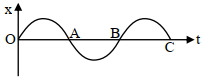
- 9The variation of displacement with time of a particle executing free simple harmonic motion is shown in the figure. The potential energy ${U}({x})$ versus time $({t})$ plot of the particle is correctly shown in figure:View Solution
- 10A simple pendulum hanging from the ceiling of a stationary lift has a time period $T_1$. When the lift moves downward with constant velocity, the time period is $T_2$, thenView Solution