If the period of oscillation of mass $m$ suspended from a spring is $2\, sec$, then the period of mass $4m$ will be .... $\sec$
AIIMS 1998, Medium
Download our app for free and get started
(d) $T = 2\pi \sqrt {\frac{m}{k}} $
==>$\frac{{{T_2}}}{{{T_1}}} = \sqrt {\frac{{{m_2}}}{{{m_1}}}} = \sqrt {\frac{{4m}}{m}} = 2$
$ \Rightarrow {T_2} = 2 \times 2 = 4\;s$

Download our appand get started for free
Experience the future of education. Simply download our apps or reach out to us for more information. Let's shape the future of learning together!No signup needed.*
Similar Questions
- 1A particle performs $SHM$ about $x = 0$ such that at $t = 0$ it is at $x = 0$ and moving towards positive extreme. The time taken by it to go from $x = 0$ to $x = \frac{A}{2}$ is ..... times the time taken to go from $x = \frac{A}{2}$ to $A$. The most suitable option for the blank space isView Solution
- 2The force-deformation equation for a nonlinear spring fixed at one end is $F =4x^{1/ 2}$ , where $F$ is the force (expressed in newtons) applied at the other end and $x$ is the deformation expressed in metersView Solution
- 3The displacement $x$ (in metres) of a particle performing simple harmonic motion is related to time $t$ (in seconds) as $x = 0.05\cos \left( {4\,\pi \,t + \frac{\pi }{4}} \right)$. The frequency of the motion will be ..... $Hz$View Solution
- 4A simple pendulum consisting of a ball of mass $m$ tied to a thread of length $l$ is made to swing on a circular arc of angle $\theta $ in a vertical plane. At the end of this arc, another ball of mass $m$ is placed at rest. The momentum transferred to this ball at rest by the swinging ball isView Solution
- 5Consider the following statements. The total energy of a particle executing simple harmonic motion depends on itsView Solution
$(1)$ Amplitude $(2) $ Period $(3)$ Displacement
Of these statements
- 6A block is resting on a piston which executes simple harmonic motion with a period $2.0 \,s$. The maximum velocity of the piston, at an amplitude just sufficient for the block to separate from the piston is .......... $ms ^{-1}$View Solution
- 7Which of the following expressions corresponds to simple harmonic motion along a straight line, where $x$ is the displacement and $a, b, c$ are positive constants?View Solution
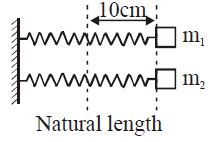
- 8The drawing shows a top view of a frictionless horizontal surface, where there are two indentical springs with particles of mass $m_1$ and $m_2$ attached to them. Each spring has a spring constant of $1200\ N/m.$ The particles are pulled to the right and then released from the positions shown in the drawing. How much time passes before the particles are again side by side for the first time if $m_1 = 3.0\ kg$ and $m_2 = 27 \,kg \,?$View Solution
- 9An object of mass $m$ is suspended at the end of a massless wire of length $L$ and area of cross$-$section, $A$. Young modulus of the material of the wire is $Y$. If the mass is pulled down slightly its frequency of oscillation along the vertical direction isView Solution
- 10The $ P.E.$ of a particle executing $SHM$ at a distance $x$ from its equilibrium position isView Solution