MCQ
A permanent magnet has the capacity to attract:
- AAll substances.
- BSome substances.
- COnly ferromagnetic substances.
- DNone of these options.
Explanation:
A permanent magnet has the capacity to attract only ferromagnetic substances.
Generate a complete, print-ready paper with questions like this in minutes — across 16+ boards, with answer keys.
Let V and H be the vertical and horizontal components of earth's magnetic field at any point on earth. Near the north pole
|
(a) V >> H |
(b) V << H |
(c) V = H |
(d) V = H = 0 |
Statement-II: For heavy nuclei, binding energy per nucleon increases with increasing Z. while for light nuclei it decreases with increasing Z.
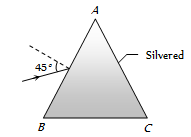
A prism ABC of angle 30° has its face AC silvered. A ray of light incident at an angle of 45° at the face AB retraces its path after refraction at face AB and reflection at face AC. The refractive index of the material of the prism is
|
(a) 1.5 |
(b) |
(c) |
(d) |
Angular width (b) of central maximum of a diffraction pattern on a single slit does not depend upon
|
(a) Distance between slit and source |
(b) Wavelength of light used |
|
(c) Width of the slit |
(d) Frequency of light used |
Beams of light are incident through the holes A and B and emerge out of the box through the holes C and D respectively as shown in the Figure. Which of the following could be inside the box?
N atoms of a radioactive element emit n alpha particles per second. The half life of the element is
|
(a) |
(b) |
(c) |
(d) |
Assertion : A pulsor is a source of radio waves which change in terms of intensity at regular interval of time
Reason : A pulsor is a rotating neutron star
|
(a) If both assertion and reason are true and the reason is the correct explanation of the assertion. |
|
(b) If both assertion and reason are true but reason is not the correct explanation of the assertion. |
|
(c) If assertion is true but reason is false. |
|
(d) If the assertion and reason both are false. |
A galvanometer, having a resistance of 50 W gives a full scale deflection for a current of 0.05 A. The length in meter of a resistance wire of area of cross-section 2.97 X 10⁻² cm2 that can be used to convert the galvanometer into an ammeter which can read a maximum of 5 A current is (Specific resistance of the wire = 5  Wm)
Wm)
|
(a) 9 |
(b) 6 |
(c) 3 |
(d) 1.5 |
If 4  energy is required to move a charge of 0.25 coulomb between two points. Then what will be the potential difference between them
|
(a) 178 V |
(b) 256 V |
(c) 356 V |
(d) None of these |
A charge of 10 e.s.u. is placed at a distance of 2 cm from a charge of 40 e.s.u. and 4 cm from another charge of 20 e.s.u. The potential energy of the charge 10 e.s.u. is (in ergs)
|
(a) 87.5 |
(b) 112.5 |
(c) 150 |
(d) 250 |


