MCQ
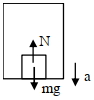
A person is standing in an elevator. In which situation, he experiences weight loss?
  • A
    When the elevator moves upward with constant acceleration
  • When the elevator moves downward with constant acceleration
  • C
    When the elevator moves upward with uniform velocity
  • D
    When the elevator moves downward with uniform velocity
Answer

Correct option: B.
When the elevator moves downward with constant acceleration
b
$mg - N = ma$

$\Rightarrow N = m ( g - a )$

$\therefore$ Person experiences weightloss, when acceleration of lift is downward.

Need a full question paper?

Generate a complete, print-ready paper with questions like this in minutes — across 16+ boards, with answer keys.

Start Generating Free

Similar questions

A bag is gently dropped on a conveyor belt moving at a speed of $2\,m / s$. The coefficient of friction between the conveyor belt and bag is $0.4$ Initially, the bag slips on the belt before it stops due to friction. The distance travelled by the bag on the belt during slipping motion is $.....m$ [Take $g=10\,m / s ^{-2}$ ]
A monoatomic ideal gas, initially at temperature ${T_1},$ is enclosed in a cylinder fitted with a frictionless piston. The gas is allowed to expand adiabatically to a temperature. ${T_2}$ by releasing the piston suddenly. If ${L_1}$ and ${L_2}$ are the lengths of the gas column before and after expansion respectively, then ${T_1}/{T_2}$ is given by
A steady electric current is flowing through a cylindrical conductor.
  1. The electric field at the axis of the conductor is zero.
  2. The magnetic field at the axis of the conductor is zero.
  3. The electric field in the vicinity of the conductor is zero.
  4. The magnetic field in the vicinity of the conductor is zero.
Select the correct choice(s) :
Figures below show water flowing through a horizontal pipe from left to right. Note that the pipe in the middle is narrower. Choose the most appropriate depiction of water levels in the vertical pipes.
Equal masses $($meach$)$ are attached at the two ends of a string passing over two pulleys. Another mass is attached at the centre of the string. In order that there is no sag in the string, this mass should be:
When air is filled in the balloon, the pressure and volume both increases while temperature does not change. Here Boyle's law is not obeyed because
A force of $5\, N$, making an angle $\theta $ with the horizontal, acting on an object displaces it by $0.4\,m$ along the horizontal direction. If the object gains kinetic energy of $1\,J$, the horizontal component of the force is......$N$
When a block of mass $M$ is suspended by a long wire of length $L$, the length of the wire become $(L+l) .$ The elastic potential energy stoped in the extended wire is :
While measuring diameter of wire using screw gauge the following readings were noted. Main scale reading is $1 \mathrm{~mm}$ and circular scale reading is equal to $42$ divisions. Pitch of screw gauge is $1 \mathrm{~mm}$ and it has $100$ divisions on circular scale. The diameter of the wire is $\frac{x}{50} \mathrm{~mm}$. The value of $x$ is :