MCQ
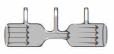
Figures below show water flowing through a horizontal pipe from left to right. Note that the pipe in the middle is narrower. Choose the most appropriate depiction of water levels in the vertical pipes.

  • B

  • C

  • D

Answer

Correct option: A.

a
$(a)$ By Bernoulli's equation for streamline flow,

$p+\frac{1}{2} \rho v^{2}+\rho g h=\text { a constant }$

In given situation $h=$ constant

$\therefore \quad p+\frac{1}{2} \rho v^{2}=$ constant

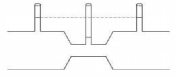
When velocity of flow in narrow section increases, pressure decreases.

So, current level in vertical tubes is as shown below.
Need a full question paper?

Generate a complete, print-ready paper with questions like this in minutes — across 16+ boards, with answer keys.
Start Generating Free

Similar questions

The potential energy of a body is given by, $U =A - B{x^2}$(Where x is the displacement). The magnitude of force acting on the particle is
The dumbell is placed on a frictionless horizontal table. Sphere $A$ is attached to a frictionless pivot so that $B$ can be made to rotate about $A$ with constant angular velocity. If $B$ makes one revolution in period $P$, the tension in the rod is
Two satellites $A$ and $B$ go round a planet in circular orbits having radii $4R$ and $R$, respectively. If the speed of satellite $A$ is $3v$, then speed of satellite $B$ is
For the four sets of three measured physical quantities as given below. Which of the following options is correct ?

$(i)$ $\mathrm{A}_{1}=24.36, \mathrm{B}_{1}=0.0724, \mathrm{C}_{1}=256.2$

$(ii)$ $\mathrm{A}_{2}=24.44, \mathrm{B}_{2}=16.082, \mathrm{C}_{2}=240.2$

$(iii)$ $\mathrm{A}_{3}=25.2, \mathrm{B}_{3}=19.2812, \mathrm{C}_{3}=236.183$

$(iv)$ $\mathrm{A}_{4}=25, \mathrm{B}_{4}=236.191, \mathrm{C}_{4}=19.5$
A liquid drop of radius R is broken up into N small droplets. The work done is proportional to( take $N^{\frac{1}{3}}>>1$ ).
The acceleration due to gravity on the earth's surface at the poles is $g$ and angular velocity of the earth about the axis passing through the pole is $\omega .$ An object is weighed at the equator and at a height $h$ above the poles by using a spring balance. If the weights are found to be same, then $h$ is $:( h << R ,$ where $R$ is the radius of the earth)
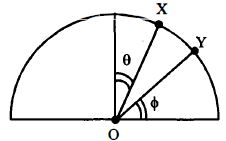
A particle is released on a vertical smooth semicircular track from point $X$ so that $OX$ makes angle $\theta $ from the vertical ( see figure). The normal reaction of the track on the particle vanishes at point $Y$ where $OY$ makes angle $\phi $ with the horizontal. Then
Visible light passing through a circular hole forms a diffraction disc of radius 0.1mm on a screen. If an X-ray is passed through the same setup, the radius of the diffraction disc will be:
A bomb is released from a horizontal flying aeroplane. The trajectory of bomb is
A ball of mass $10\, kg$ moving with a velocity $10 \sqrt{3} m / s$ along the $x-$axis, hits another ball of mass $20\, kg$ which is at rest. After the collision, first ball comes to rest while the second ball disintegrates into two equal pieces. One piece starts moving along $y-$axis with a speed of $10$ $m / s$. The second piece starts moving at an angle of $30^{\circ}$ with respect to the $x-$axis. The velocity of the ball moving at $30^{\circ}$ with $x-$ axis is $x\, m / s$. The configuration of pieces after collision is shown in the figure below. The value of $x$ to the nearest integer is